Fighting Game Notation Explained: Numpad, Tekken and Smash Inputs
Learn to read fighting game combo notation: numpad directions, button names, Tekken's 1/2/3/4 system, Smash shorthand and symbols like xx, > and ~.
Open any combo guide, wiki page or community spreadsheet for a fighting game and you will run into strings like 2MK xx 236HP, c.S > 2H > 236K or df1, 2 ~ f. To a newcomer they look like a password. In reality they are a compact, surprisingly consistent language that players have refined over decades so they can share combos, setups and punishes without writing out “crouch and press medium kick, then cancel into a fireball motion with heavy punch.”
This guide teaches you to read the three notation families you will meet most often: numpad notation (used for Street Fighter, Guilty Gear, King of Fighters and most 2D games), Tekken’s limb-based notation, and the plain-English shorthand of Super Smash Bros. Once you can read them, every guide on the internet opens up.
Why Fighting Games Need Their Own Notation
Older guides wrote inputs as words or arrows: “down, down-forward, forward + punch.” That works for one move, but combos chain five, ten or twenty actions together, and the words quickly become unreadable. Different games also call the same thing different names, and arrow symbols do not always survive being pasted into forums or chat apps.
Notation solves three problems at once:
- Brevity. A full combo fits on one line.
- Precision. It distinguishes between a link, a cancel and a chain, which are very different timings.
- Portability. Numbers and letters type the same on every keyboard and in every language.
Notation always assumes your character is facing right. If your character is on the right side of the screen facing left, every “forward” and “back” flips in your hands, but the notation does not change.
Numpad Notation: The Universal Directions
Numpad notation maps the eight joystick directions, plus neutral, onto the number pad of a keyboard or calculator. Look at a keyboard’s numpad and imagine the 5 key is your joystick at rest:
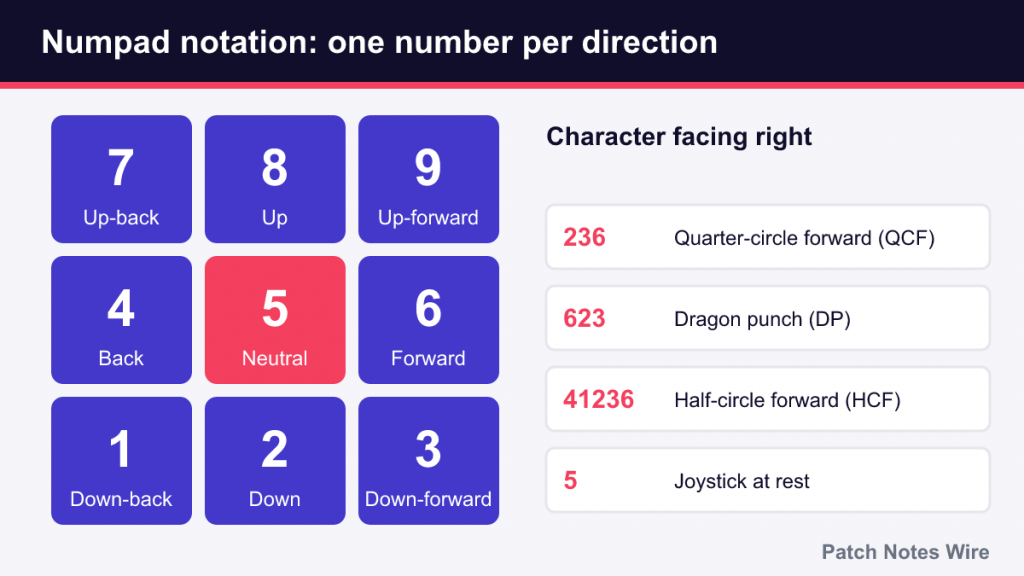
| Number | Direction | Number | Direction |
|---|---|---|---|
| 7 | Up-back | 9 | Up-forward |
| 8 | Up | 6 | Forward |
| 4 | Back | 3 | Down-forward |
| 1 | Down-back | 2 | Down |
| 5 | Neutral (nothing held) | — | — |
A single number before a button tells you which direction is held while you press it. 5LP is a standing light punch, 2MK is a crouching medium kick, 6HP is forward plus heavy punch. Many communities drop the 5 for standing normals, but writing it removes any doubt.
Motion inputs as numbers
Special moves are written as the sequence of directions you roll through. These are the ones you will see constantly:
| Numpad | Common name | Classic example |
|---|---|---|
| 236 | Quarter-circle forward (QCF) | Ryu’s Hadoken |
| 214 | Quarter-circle back (QCB) | Ryu’s Tatsumaki |
| 623 | Dragon punch motion (DP) | Ryu’s Shoryuken |
| 421 | Reverse dragon punch | Various command moves |
| 41236 | Half-circle forward (HCF) | Many supers and command throws |
| 63214 | Half-circle back (HCB) | Many command throws |
| 360 / 632147896 | Full circle | Zangief’s Spinning Piledriver |
| [4]6 | Back charge, then forward | Guile’s Sonic Boom |
| [2]8 | Down charge, then up | Guile’s Somersault Kick |
| 66 / 44 | Forward dash / backdash | Universal |
Square brackets mean “hold.” So [4]6P means hold back for the charge time, then press forward and punch. Some guides use the same bracket idea for buttons: [P] means hold punch, and ]P[ means release it, which matters for characters with negative-edge or hold-and-release moves.
Button Labels Across Different Series
Directions are universal; buttons are not. Each series has its own naming scheme, and notation simply uses the game’s own labels.
| Series | Buttons | Meaning |
|---|---|---|
| Street Fighter (Classic controls) | LP, MP, HP, LK, MK, HK | Light, medium, heavy punch and kick |
| Street Fighter (older shorthand) | jab, strong, fierce, short, forward, roundhouse | The same six buttons by their arcade-era names |
| King of Fighters and many SNK games | A, B, C, D | Light punch, light kick, heavy punch, heavy kick |
| Guilty Gear Strive | P, K, S, H (or HS), D | Punch, kick, slash, heavy slash, dust |
| Many anime fighters | L, M, H, S or A, B, C, D | Light, medium, heavy, special or unique button |
| Tekken | 1, 2, 3, 4 | Left punch, right punch, left kick, right kick |
Abbreviations stack: “P” alone often means “any punch,” “K” means “any kick,” and “PP” or “KK” means two punches or two kicks pressed together. When a specific strength matters, the guide will spell it out, for example 236HP rather than 236P.
Street Fighter 6’s Modern control type uses its own labels (Light, Medium, Heavy, plus a Special button and an Assist button), so you may see guides written separately for Classic and Modern players. Numpad directions still apply to both.
Prefixes and Combo Symbols
Beyond directions and buttons, notation uses small prefixes and connecting symbols. Dustloop, the main wiki for Arc System Works games, maintains a long list, and most 2D communities follow the same conventions.
Prefixes that describe the state of your character
- j. — jumping. j.HP is a jumping heavy punch.
- c. or cl. — close. Some games give a different normal when you are near the opponent, such as close slash (c.S) in Guilty Gear.
- f. or far — far version of a proximity normal, such as f.S.
- cr. and st. — crouching and standing, an alternative to 2 and 5 that is common in Street Fighter communities (cr.MK = 2MK).
- sj. or hj. — super jump or high jump.
- CH — counter hit, meaning the hit must interrupt the opponent’s attack for the combo to work.
- IAD — instant air dash, an air dash done as low to the ground as possible.
- tk. — tiger knee, a ground motion that ends in an up direction so the special comes out just off the ground.
Symbols that connect moves
| Symbol | Meaning |
|---|---|
| > | Do the next move after the previous one; in many games it implies a chain or cancel |
| , | Link: the first move must fully recover before the next is pressed |
| xx | Cancel: interrupt the first move’s recovery with a special or super |
| ~ or -> | Follow-up: a special that continues into another special |
| jc / sjc | Jump cancel / super jump cancel |
| dl. or (delay) | Wait slightly before the next input |
| whiff | The move must miss on purpose |
| xN | Repeat the sequence N times |
| ( ) | Optional move |
| / | Choose either button, e.g. MP/HP |
The distinction between , and xx is the single most important thing to understand. A link requires timing your second press after the first move ends. A cancel happens during the first move, which is usually much more forgiving. If a combo feels impossible, check whether you are linking something that should be canceled, or vice versa.
Tekken Notation: Limbs Instead of Strengths
Tekken does not have light, medium and heavy. Each button is a limb, so the notation is built on numbers:
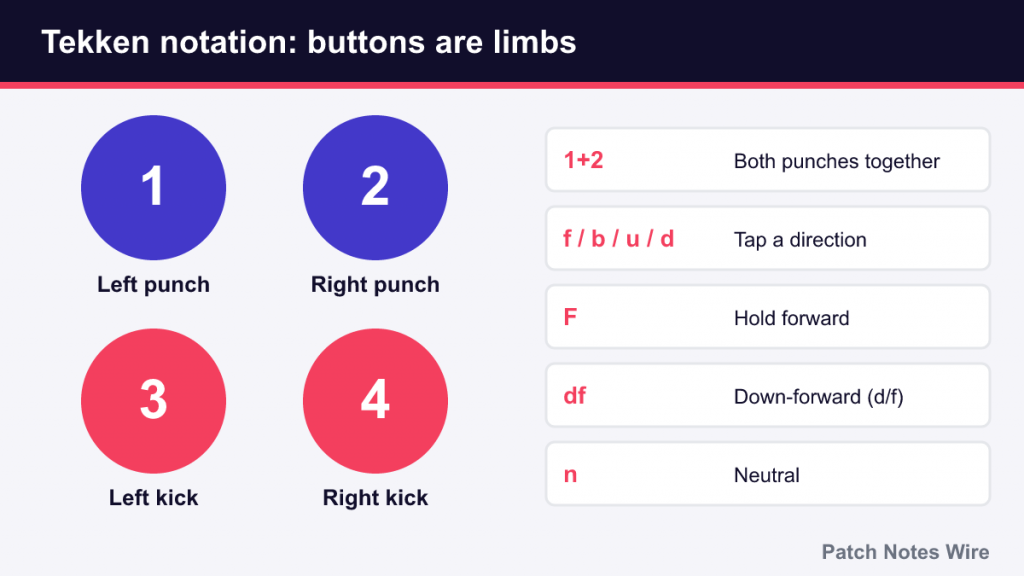
- 1 left punch, 2 right punch, 3 left kick, 4 right kick.
- + means pressed together, so 1+2 is both punches at once.
Directions are written as letters rather than numpad numbers: f forward, b back, u up, d down, and n neutral. Diagonals combine them, written as d/f in older guides and df on modern resources such as the Wavu Wiki. A lowercase letter means tap; an uppercase letter means hold. So f+2 is tap forward with right punch, while F means keep holding forward.
Tekken sequence symbols
- , — followed by, for strings: 1,2 is the basic one-two jab string.
- ~ — followed immediately, as in f~n.
- : — a tight, just-frame style timing window.
- < > or “delay” — a deliberately delayed input in a string.
Tekken state abbreviations
| Abbreviation | Meaning |
|---|---|
| ws | While standing: the move done as you rise from a crouch (ws2, ws4) |
| FC | Full crouch |
| SS, SSL, SSR | Sidestep, sidestep left, sidestep right |
| CD | Crouch dash (f, n, d, df) |
| WR | While running (f,f,f) |
| BT | Back turned |
| qcf / qcb | Quarter circle forward / back (d, df, f) |
| H. | During Heat (Tekken 8) |
Tekken combo guides also use short tags for game-specific mechanics: T! marks a Tornado hit (a move that spins the airborne opponent and lets the combo continue), and dash or ff indicates a step forward between hits.
Smash Bros. Shorthand
Super Smash Bros. does not use motion inputs in the traditional sense, so its notation is closer to plain abbreviations of move names. The direction and the button type define the move:
- Jab — neutral A on the ground.
- Tilts — light directional attacks: ftilt, utilt, dtilt.
- Smash attacks — strong charged attacks: fsmash, usmash, dsmash.
- Aerials — attacks in the air: nair (neutral), fair (forward), bair (back), uair (up), dair (down).
- Specials — the B button moves: neutral B, side B, up B, down B.
- Grab and throws — fthrow, bthrow, uthrow, dthrow.
Movement and technique abbreviations fill in the rest: SH (short hop), FH (full hop), DJ (double jump), FF (fast fall), DI (directional influence) and RAR (reverse aerial rush). A Smash combo might read dthrow > uair > uair, which is far easier to parse than most 2D strings.
Worked Examples: Reading Real Combo Strings
Here are a few typical strings broken down step by step. They are illustrative patterns rather than optimal combos for any specific character.
Example 1: A classic Street Fighter confirm
2LK, 2LP xx 236LP
- Crouching light kick.
- Link into crouching light punch (the comma tells you to wait for recovery).
- Cancel the light punch into a quarter-circle-forward special with light punch.
Example 2: A Guilty Gear-style gatling
c.S > 2H > 236K
- Close slash.
- Chain (gatling) into crouching heavy slash.
- Cancel into the character’s quarter-circle-forward kick special.
Example 3: A jump-in with a charge special
j.HK > 5HP xx [4]6HP
- Jumping heavy kick on the way down.
- Standing heavy punch when you land.
- Cancel into a back-charge special. You need to have been holding back long enough beforehand, which usually means holding down-back (1) during the jump and the standing normal.
Example 4: A Tekken punish and launcher
ws4, 1,2 and df2, ff 1,2
- The first is a while-standing right kick, followed by a one-two string.
- The second is a down-forward right punch, then a forward dash, then a one-two.
Common Mistakes When Reading Notation
- Forgetting side switches. Notation assumes you face right. On the other side, 6 is still “toward the opponent,” which is left on your controller.
- Treating every comma the same. In 2D games a comma is a link; in Tekken it simply means “next in the string.” Always check which game a guide is written for.
- Ignoring prefixes. c.S and f.S are different moves with different properties. Mixing them up will drop the combo.
- Doing motions too slowly. 236 is a quick roll, not three distinct presses. Many games have input leniency, but there are limits.
- Assuming every wiki uses identical symbols. Most guides include a legend at the top. Read it once; it saves frustration later.
Quick Reference Cheat Sheet
| You see | It means |
|---|---|
| 5 / 2 / 6 / 4 + button | Standing / crouching / forward / back + button |
| 236 / 214 / 623 | Quarter-circle forward / quarter-circle back / dragon punch |
| [4]6 | Charge back, then forward |
| j. / c. / f. | Jumping / close / far |
| , / > / xx | Link / next move (often chain) / cancel |
| 1 2 3 4 (Tekken) | Left punch, right punch, left kick, right kick |
| f b u d, uppercase | Tekken directions, held if uppercase |
| ws / FC / SS | While standing / full crouch / sidestep |
| nair, fair, bair, uair, dair | Smash aerials |
| CH | Counter hit required |
Practice by taking one combo from a wiki, writing out each step in plain English, then trying it in training mode with input display turned on. After a handful of combos, the shorthand starts to read like normal text, and you can move on to the next big concept: why some combos link and others do not, which comes down to frame data.