Anime Fighting Games Explained: Airdashes, Bursts and Fast Offense
What makes a fighting game an "anime fighter": airdashes, bursts, gatlings and special guards, with Guilty Gear, BlazBlue, DBFZ and Under Night as examples.

“Anime fighter” is one of the most used labels in fighting game communities, and also one of the least precise. It sounds like it describes the art style, and partly it does, but players actually use it to describe a set of gameplay traits: fast movement, airdashes, long combos, bursts and offense-heavy design. Plenty of games with anime visuals do not play like “anime fighters,” and the term is really about how the game plays. This guide explains what the subgenre is, the mechanics that define it and how it differs from Street Fighter-style games.
Where the Subgenre Comes From
The modern anime fighter grew out of Japanese developers in the 1990s and 2000s who took the Street Fighter II template and pushed it toward speed and air mobility. Arc System Works’ Guilty Gear, first released on the PlayStation in 1998, is the most influential of them. Its fast movement, airdashes and aggressive offense set the expectations for the subgenre. Later series such as BlazBlue (also by Arc System Works, starting in arcades in 2008), Melty Blood and Under Night In-Birth (by French-Bread) and many others built on the same foundation.
Today, Arc System Works is the best-known developer of the style, with games including Guilty Gear Strive, Dragon Ball FighterZ, Granblue Fantasy Versus: Rising (co-developed with Cygames) and Marvel Tokon: Fighting Souls, released in August 2026 for PS5 and PC.
The Major Games at a Glance
| Game | Developer | Notable traits |
|---|---|---|
| Guilty Gear Strive (2021) | Arc System Works | Roman Cancels, Wall Break, big damage, streamlined for newcomers |
| BlazBlue series (2008 onward) | Arc System Works | Character-specific Drive button, long combos, Barrier guard |
| Dragon Ball FighterZ (2018) | Arc System Works | 3v3 teams, assists, auto-combos, homing Super Dash |
| Granblue Fantasy Versus: Rising (2023) | Arc System Works / Cygames | Slower, more grounded pace, simplified skill inputs |
| Under Night In-Birth II Sys:Celes (2024) | French-Bread | GRD system rewarding positive play, fast but grounded |
| Marvel Tokon: Fighting Souls (2026) | Arc System Works | Team-based Marvel fighter in an anime-inspired style |
Granblue Fantasy Versus is a useful example of how loose the label is: it shares Arc System Works’ look, but its ground-based pace has more in common with Street Fighter than with Guilty Gear. Whether a game counts as an “anime fighter” is ultimately a question of how it plays.
Airdashes, Double Jumps and Air Mobility
The single biggest difference between anime fighters and traditional fighters is movement in the air.
Airdashes
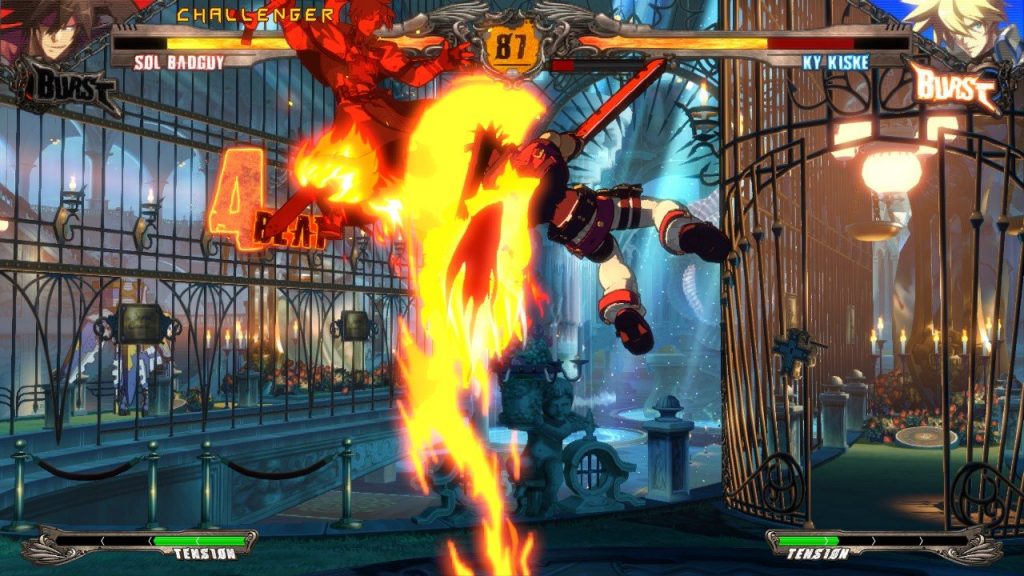
Most anime fighters let characters dash horizontally in the air after jumping. Airdashes give players a fast, flexible way to approach and change trajectory mid-jump. In a Street Fighter game, a jump follows a fixed arc and is easy to predict and anti-air; in an anime fighter, an airdash can change your approach angle and timing, making anti-airs harder.
Double jumps and super jumps
Many characters can jump twice, and most games include a higher “super jump” (or high jump). Combined with airdashes, this creates a large set of aerial approach options.
Instant air dashes
An “instant air dash” (IAD) is an airdash done as low to the ground as possible, immediately after leaving the ground. It is a fast way to approach and can make jumping attacks hit as overheads very quickly. IADs are one reason anime fighters feel so fast.
The result
Air mobility makes neutral in anime fighters more about controlling space in two dimensions. Anti-air is still important, but you cannot rely on a single dragon punch to stop every jump the way you might in Street Fighter.
Combo Systems: Gatlings and Auto-Combos
Gatlings
Most anime fighters let normal attacks cancel into each other in a set order, a system Arc System Works calls gatlings. In practice, this means pressing buttons in ascending strength often produces a valid combo. This is why anime fighters can feel easier to start than traditional fighters, even though their combos are often long. Our guide to links, cancels and chains covers the general mechanics.
Auto-combos
Dragon Ball FighterZ and Granblue Fantasy Versus include auto-combos: pressing one button repeatedly produces a full combo. These are less damaging than manual combos but make the games approachable. Guilty Gear Strive and others have simplified combo routes rather than full auto-combos.
Long combos and launchers
Air combos, wall bounces, ground bounces and launchers are common, which means combos in anime fighters can be longer than in Street Fighter. Damage scaling (proration) limits the damage, but a single opening can still decide a round.
Bursts and Comeback Mechanics
A burst is a defensive mechanic that lets a player who is being hit (or is under pressure) break out of an opponent’s combo or offense, at the cost of a resource. In Guilty Gear Strive, the Psych Burst comes in two forms: a defensive “blue” burst used while being hit or blocking, which knocks the attacker away, and an offensive “gold” burst used in neutral, which refills tension when it hits. Both cost a full Burst Gauge.
Bursts exist because anime fighter combos are long and damaging. Without them, a single opening would often be too decisive. But bursts can be baited: if an opponent expects a burst, they can block it or stop their combo to avoid it, and then punish you while you are vulnerable. Knowing when to burst, and when to bait one, is a big part of high-level play.
Other games have their own equivalents and comeback tools. Dragon Ball FighterZ uses Sparking Blast, a once-per-match power-up whose strength scales with how many characters you have lost. Many games also give a character a damage or meter boost at low health.
Special Guards: Instant Block, Faultless Defense and Others
Anime fighters tend to give defenders more tools than traditional fighters, partly to balance their strong offense.
- Instant Block (Guilty Gear): blocking just before an attack connects removes the defender’s pushback, prevents chip damage and builds more Tension, potentially opening a gap in the opponent’s pressure.
- Faultless Defense (Guilty Gear): a meter-consuming block that prevents chip damage and pushes the attacker away, helping escape pressure.
- Barrier (BlazBlue): a similar meter-based block that increases pushback.
- Shield (Under Night): a defensive technique that can reward correctly guarding an attack.
- Air blocking: many anime fighters allow blocking in the air, which Street Fighter generally does not. Some attacks cannot be air blocked, which creates its own strategy.
How Anime Fighters Differ From Street Fighter
| Aspect | Typical anime fighter | Typical Street Fighter |
|---|---|---|
| Movement | Airdashes, double jumps, high mobility | Fixed jump arcs, ground dashes |
| Combo structure | Gatlings, long air combos | Links and cancels, shorter combos |
| Defense | Bursts, special guards, air blocking | Blocking, parries and meter-based escapes |
| Pace | Fast, offense-heavy | More grounded, focused on footsies |
| Inputs | Motion inputs plus simplified options | Motion inputs (Classic) or simplified (Modern) |
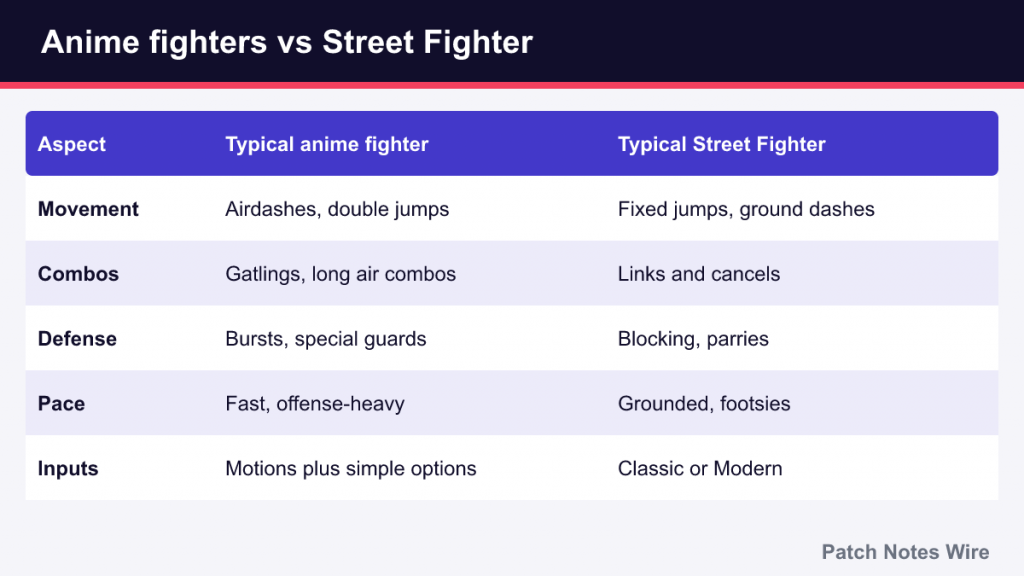
These are generalizations. Street Fighter 6’s Drive Rush gives it fast offense, and Granblue Fantasy Versus plays more like Street Fighter than Guilty Gear. But the table captures the overall feel.
Unique Systems Worth Knowing
Roman Cancels (Guilty Gear)
Guilty Gear’s Roman Cancels let a player spend half their Tension gauge to cancel almost any action, extending combos, making unsafe moves safe or creating new offensive situations. They are a signature of the series.
GRD (Under Night In-Birth)
Under Night’s GRD (Grind Grid) system rewards moving forward, attacking and successful defense. Whoever has more GRD at the end of a cycle enters Vorpal state and gains a damage bonus plus special options. It turns positive play into a tangible advantage.
Assists and tag (Dragon Ball FighterZ)
DBFZ is a 3v3 tag game where characters can be called in as assists. This creates layered offense and combos, and it borrows heavily from the Marvel vs. Capcom tradition.
Drive (BlazBlue)
Each BlazBlue character has a unique “Drive” button, a special mechanic tied to that character’s identity. This gives BlazBlue’s roster an unusual variety of playstyles.
Defending Against Anime-Fighter Offense
New players often feel that anime fighters are all offense and no defense. In reality, the defensive layer is just as deep; it simply takes longer to learn. A few principles apply across most games in the subgenre:
- Know the overheads. Jump-ins and instant air dashes create fast overheads. When an opponent leaves the ground close to you, be ready to block high, then switch back to a low block as they land.
- Use special guards to create space. A meter-based guard like Faultless Defense pushes the attacker away, which can turn a long blockstring into a return to neutral.
- Watch for gaps. Gatling strings often contain small gaps where you can interrupt with a fast attack or an invincible move. Training mode can show you where they are.
- Do not mash. Pressing buttons randomly under pressure is exactly what frame traps are designed to catch.
- Save the burst for the right moment. A burst used to escape a combo that leads to a large amount of damage is worth far more than one used at the start of a minor string.
Learning defense in an anime fighter is mostly about patience. Once you can block a character’s standard pressure calmly, you will notice how many openings they leave.
Are Anime Fighters Good for Beginners?
Often, yes. Gatlings and auto-combos make it easy to do real combos early, and modern anime fighters have invested heavily in tutorials and accessibility. Guilty Gear Strive in particular was designed to be more approachable than earlier Guilty Gear games while keeping much of the series’ identity. The challenge is the pace: there is a lot happening at once, and defense against airdash mix-ups takes time to learn.
A good approach is to pick a game with an active community and good tutorials, focus on one character and learn the defensive systems early, especially bursts and special guards. If you are still deciding between game styles, our guide on choosing your first fighting game compares the major options.