Combos Explained: Links, Cancels, Chains and Target Combos
Links, cancels, chains, target combos and juggles explained in plain English, plus damage scaling, input buffers and how combo routes are written.
A combo is a sequence of attacks that the opponent cannot block or escape once the first hit lands. That simple definition hides a lot of variety. Street Fighter combos are built from carefully timed links and cancels, Tekken combos are mostly air juggles after a launcher, and anime fighters like Guilty Gear let you chain normals together in quick succession. This guide breaks down the building blocks that every combo is made from, explains why combos do less damage the longer they go, and shows how combo routes are written so you can read community guides.
What Makes Something a Combo
When a move hits, the opponent is stuck in hitstun for a certain number of frames. If your next attack connects before that hitstun ends, the opponent cannot block it, and the hits form a combo. Most games display a hit counter to confirm this. If the counter resets, the opponent had a chance to block or act between hits, and the sequence was not a true combo.
Everything in this article comes down to one question: how do you get your next attack to start quickly enough to hit before hitstun runs out? Each technique below is a different answer. If frames are new to you, our frame data guide covers startup, recovery and frame advantage in detail.
Links
A link is when one attack fully finishes its animation and the next attack is started afterwards, but still connects because the first move left the opponent in hitstun long enough. In frame terms, the first move must be plus enough on hit to cover the second move’s startup.
Example: if a move is +5 on hit and your next attack has 4 frames of startup, you can link them, with one frame of leeway. If the next attack has 6 frames of startup, it will not combo no matter how fast you press it.
Links are traditionally the hardest combo element in Street Fighter because they require timing. Many modern games add an input buffer, which lets you press the next button a few frames early and still have it come out on the first possible frame, making links far more forgiving than they were in older games.
Plinking and other old tricks
In some older games, players used techniques like “plinking” (pressing two buttons in quick succession so the game reads the input twice) to make tight links easier. These tricks are mostly unnecessary in modern games with generous buffers, but you will still see them mentioned in older guides.
Cancels
A cancel interrupts the animation of one move to start another one immediately. Usually you cancel a normal attack into a special move: the special starts during the normal’s recovery (or even during its active frames), so the combo flows without a gap.
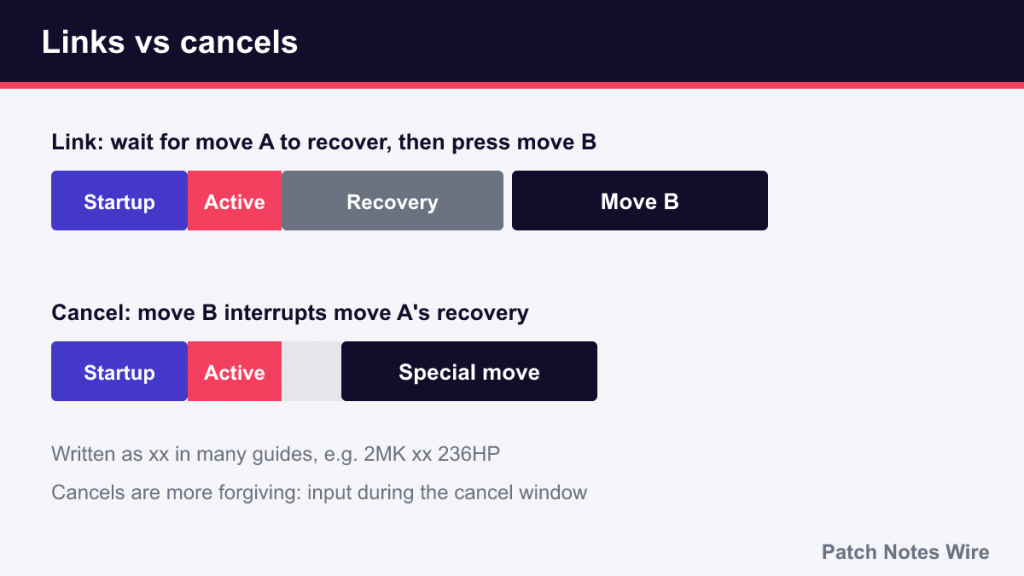
Cancels are the backbone of Street Fighter combos. A common pattern is a normal attack canceled into a special move (written with “xx” in many guides), then the special canceled into a super. Not every move can be canceled; frame data tables usually mark which normals are cancelable and into what.
Why cancels are easier than links
Because you do not need to wait for the first move to finish, cancels are generally more forgiving. You only need to complete the special move’s input during the cancel window. Buffering the motion during the normal (doing the motion as the normal comes out, then pressing the button) is standard practice.
Cancels as a defensive tool
Cancels also make you safer. If a poke is blocked, you can often cancel it into a safe special move, or not cancel at all. This leads directly to the concept of a hit confirm: checking whether a move hit before committing to a cancel that would be unsafe on block.
Chains and Gatlings
A chain is when normal attacks cancel directly into other normals in a predetermined order, usually from weaker to stronger. Classic examples are the “light into medium into heavy” sequences found in many Capcom and SNK games, and the way Street Fighter’s light attacks can chain into each other.
Arc System Works games call their chain systems gatlings. In Guilty Gear, normals can be canceled into a specific set of other normals defined by each character’s gatling table, which makes combos feel fluid and easy to begin. Chains are a big reason anime fighters feel more accessible at the start: pressing buttons in an ascending order often produces a real combo.
Chains vs cancels
A chain cancels normals into normals following a fixed system. A cancel generally refers to normals going into special moves or supers. The difference is mostly about which moves are allowed to interrupt which, and both remove the timing gap that a link needs.
Target Combos
A target combo is a specific, predefined sequence of normals that only works in that order, often with unique animations. Many Street Fighter characters have them; pressing one normal and then another within a window produces a special follow-up that would not exist otherwise. Target combos are character-specific, unlike chains, which apply broadly to a character’s moveset.
Tekken strings work on a similar principle. A Tekken string like “1, 2” or “1, 1, 2” is a predefined sequence of attacks. However, not all string hits are guaranteed to combo; some strings have gaps that the opponent can interrupt or duck. Learning which strings are “natural combos” (guaranteed on hit) is part of learning a Tekken character.
Juggles
A juggle is a combo performed on an airborne opponent. In many 2D games, juggles are a small part of combos, often following launchers or specific knockdown moves. In 3D fighters, juggles are central.
Tekken juggles
In Tekken, most big combos start with a launcher, a move that sends the opponent into the air. You then follow with a sequence of hits while they fall. Over the series, Tekken has introduced juggle extenders: Tekken 6 introduced Bound, which slammed a juggled opponent into the floor and bounced them back up; Tekken 7 replaced that role with the Screw (often called “tailspin”); and Tekken 8 uses Tornado hits in the same role. Walls and floor breaks also extend juggles. A typical Tekken combo route is “launcher, a few filler hits, Tornado move, dash, ender.”
Juggle limits
Most games limit juggles in some way, through gravity that pulls the opponent down faster as the combo goes on, through juggle point systems, or by making certain moves unable to hit an airborne opponent. These limits keep combos from going on forever.
Damage Scaling
Almost every modern fighting game reduces the damage of each hit as a combo continues. This is damage scaling (also called proration in some communities). Without it, long combos would be absurdly powerful.
Scaling usually works in a few layers:
- Per-hit scaling: each additional hit does a smaller percentage of its normal damage.
- Starter scaling: some moves apply extra scaling to the rest of the combo when they start it. Light attacks commonly scale harder than heavy attacks, which is why combos from a heavy hit tend to do more damage.
- Minimum scaling: most games have a floor below which damage stops decreasing. Street Fighter 6’s usual minimum is 10%, though some mechanics, such as using a Drive Rush mid-combo or starting from a Perfect Parry, apply further reductions on top.
- Special cases: in Guilty Gear Strive, mechanics like a Purple Roman Cancel can apply forced proration, and some games protect supers with a minimum damage guarantee.
The practical lessons are simple. Start combos with your strongest reliable hit when you can. A shorter combo with a strong starter often does more damage than a long one from a weak starter. And if a combo is extremely long, the final hits may be doing very little damage; ending early with a strong knockdown may be a better choice.
Input Buffers
An input buffer is a window during which the game remembers your input and executes it as soon as possible. Modern games commonly buffer button presses for a few frames during another move’s recovery, which makes links and cancels easier. Buffers also exist for special move motions: you can do the motion during a normal and press the button at the right time to cancel. The exact size of a game’s buffer varies; community wikis such as SuperCombo and Dustloop list them for each game.
How Combo Routes Are Written
Community combo notation uses a few conventions. Our notation guide covers them in detail, but here are the key symbols:
| Symbol | Meaning |
|---|---|
| > or , | Followed by (link, chain or next hit) |
| xx | Cancel into |
| ~ | Immediately into, often used for target combos or follow-ups |
| j. | Jumping attack |
| 2, 5, 6 (numpad) | Crouching, standing, forward direction |
| dash, dl., [ ] | Dash, delay, hold |
So a route like “2MK xx 236HP” means crouching medium kick canceled into a heavy quarter-circle-forward special. In Tekken notation, something like “df+2, 1, 2” reads as down-forward with right punch, followed by left punch and right punch.
How to Practise Combos
- Learn one bread-and-butter combo per starter type: from a light attack, from a heavy attack and from a punish. These cover most situations.
- Practise on both sides. Inputs feel different facing left and right.
- Practise hit confirming. Set the dummy to block randomly and only finish the combo when the first hit connects.
- Practise from realistic situations. A combo you can only do from a standstill in training mode is not ready for a match. Combine it with movement and pokes.
- Do not chase optimal damage too early. A simple combo you land every time beats a complex one you drop half the time.
Combos are the reward for winning the neutral game, which is covered in our guide to footsies and neutral. Learn both together, and each makes the other more valuable.