Frame Data Explained: Startup, Active, Recovery and Frame Advantage
What startup, active and recovery frames mean, how plus and minus on block work, and how to use frame data to know what is safe and what to punish.
Every fighting game player eventually hits the same wall. You block an opponent’s attack, press a button, and get hit anyway. Or you block a big flashy move, try to retaliate, and your attack somehow does not come out in time. The explanation in both cases is frame data: the precise timing information that describes how fast every attack starts, how long it lasts and how long it leaves its user vulnerable.
Frame data has a reputation for being a wall of numbers for hardcore players only. In practice you need just a handful of concepts to get value from it, and both Street Fighter 6 and Tekken 8 now show much of this information directly in training mode. This guide explains the vocabulary and, more importantly, what to actually do with it.
What Is a Frame?
Fighting games run at a fixed speed, and the standard for modern fighters such as Street Fighter 6, Tekken 8, Mortal Kombat 1 and Guilty Gear Strive is 60 frames per second. One frame is therefore one-sixtieth of a second, roughly 16.7 milliseconds. Game logic updates once per frame: inputs are read, characters move, hitboxes are checked.
Because the speed is fixed, every move can be described in frames, and the description is exact. A move with 5 frames of startup always takes 5 frames to become dangerous, no matter who uses it or what connection they are on. That consistency is what makes frame data useful: it turns “that feels fast” into a number you can compare.
For reference, human reaction time to a visual stimulus is generally described as somewhere around a quarter of a second, which is about 15 frames. That is why moves faster than this are hard to react to, and why a lot of high-level play is about anticipating rather than reacting.
The Three Phases of Every Attack
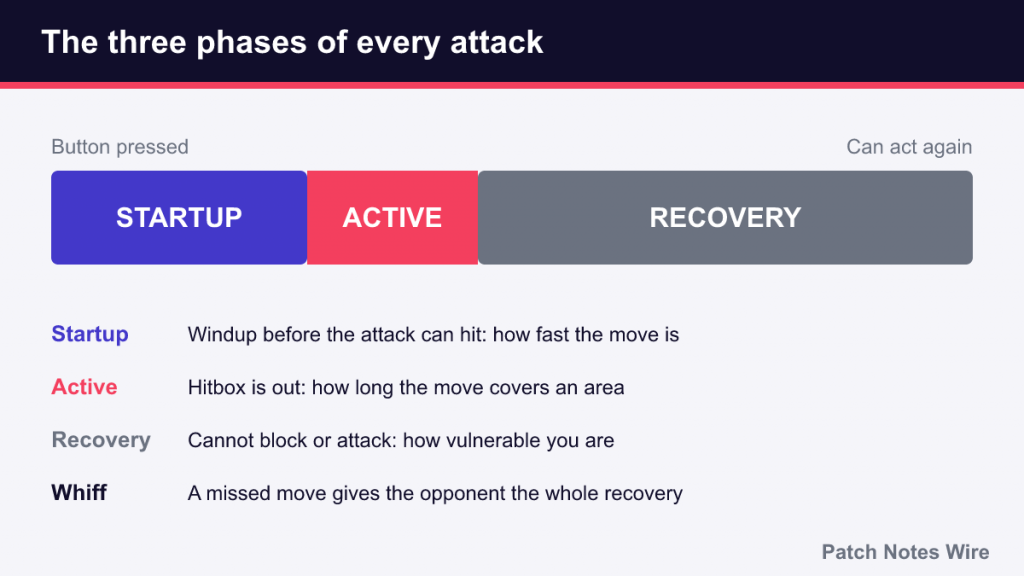
Every attack in a fighting game can be split into three consecutive phases.
| Phase | What happens | Why it matters |
|---|---|---|
| Startup | The windup before the attack can hit | Determines how fast the move is |
| Active | Frames during which the hitbox can connect | Determines how long the move “covers” an area |
| Recovery | The character returns to a neutral state and cannot act | Determines how vulnerable you are afterward |
Startup
Startup is the number of frames from pressing the button until the attack can hit. One detail trips up many players: different games count it differently. In Street Fighter 6 and most 2D games, the listed startup usually includes the first active frame, so a “5-frame” move hits on frame 5. Tekken writes startup with an “i” prefix, such as i10, which means the move hits on the tenth frame. The practical point is the same: lower is faster.
Active frames
Active frames are the window in which the attack’s hitbox is out. A move with many active frames is good at catching opponents who walk or jump into it, and good for “meaty” attacks, where you time the attack so its later active frames overlap with the opponent standing up from a knockdown.
Recovery
Recovery frames are the period after the hitbox disappears when your character is still finishing the animation. During recovery you cannot block or attack. Big moves typically have long recovery, which is the price of their reward.
Add the three together and you get the total duration of a move. If it misses completely (a whiff), the opponent has the whole recovery period to hit you, which is the basis of the skill called whiff punishing.
Frame Advantage: Plus, Minus and Why It Matters
When an attack connects, the defender is stuck in either hitstun (if they got hit) or blockstun (if they blocked). Frame advantage compares how long the attacker remains in recovery against how long the defender remains stuck.
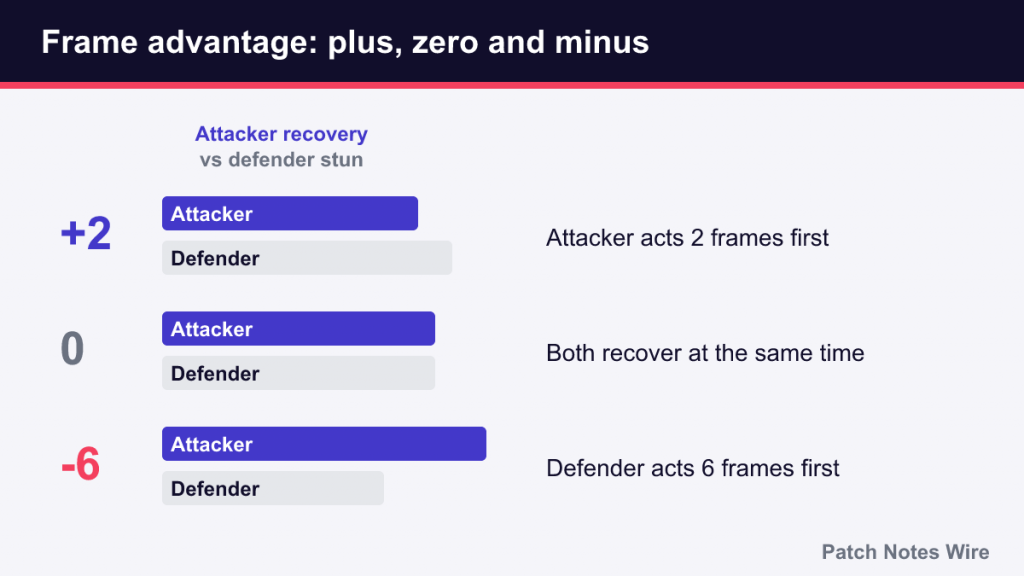
- Plus (+): the attacker recovers first. +2 means you can act 2 frames before your opponent.
- Zero (0): both players recover at the same time.
- Minus (−): the defender recovers first. −6 means the opponent can act 6 frames before you.
Frame data tables usually list two values: on hit and on block. Many games also list on counter hit, since a hit that interrupts the opponent’s own attack often gives extra advantage. Street Fighter 6 adds Punish Counter, a stronger counter state that applies when you hit an opponent during their recovery.
Reading advantage in practice
If your move is +1 on block and both players press a 4-frame jab right afterward, yours hits first because you started 1 frame earlier. If your move is −2 on block and you press a jab, your opponent’s equally fast jab wins. Frame advantage, in other words, tells you who has the right to press a button next. Players call that having “your turn.”
Being slightly minus is normal and not a disaster. Most attacks in most games are a few frames minus on block. The number only becomes a problem when the opponent has a move fast enough to exploit it.
Safe, Unsafe and Punishable
A move is punishable when it leaves you so minus on block that the opponent’s fastest attack is guaranteed to hit before you can block again. The threshold depends on the defender’s options.
Take Tekken 8 as an example. Most characters have a 10-frame jab, so a move that is −10 or worse on block can be punished by at least a jab. Kazuya’s standing jab (1) is listed at i10, +1 on block and +8 on hit, while his df+2 launcher is i14 and −12 on block on Tekkendocs at the time of writing. That means blocking df+2 guarantees you a punish of up to 12 frames of startup. Moves that are −15 or worse on block can often be punished by launchers, which is why that number is a common landmark in Tekken.
In Street Fighter 6, light attacks typically start in 4 or 5 frames, so a move that leaves the attacker −4 or worse on block can generally be punished by a light attack, and bigger deficits allow bigger punishes. A blocked Shoryuken-style invincible uppercut is the classic example: it is enormously minus, and the defender can respond with their most damaging combo.
Safe on block is not the same as safe
Remember that frame data on block assumes the move was blocked. A move that is safe on block can still be whiff-punished if it misses, and many moves are punishable by specific tools such as invincible reversals or armored attacks. “Safe” always means “safe against the specific response you are checking.”
How to Read an Official Frame Data Table
Street Fighter 6 publishes frame data for every character on the character pages of Capcom’s official Street Fighter 6 website, and the training mode includes a frame meter. Tekken 8’s practice mode shows startup and frame advantage on screen, and community sites such as Tekkendocs and the Wavu Wiki compile complete tables. A typical table looks like this (illustrative values, not tied to a specific character):
| Move | Startup | Active | Recovery | On Hit | On Block | Cancel |
|---|---|---|---|---|---|---|
| Standing light punch | 4 | 3 | 7 | +4 | −1 | Chain, special |
| Crouching medium kick | 8 | 3 | 17 | +2 | −6 | Special |
| Heavy uppercut special | 6 | 11 | 35 | Knockdown | −32 | Super |
Here is how to read each row:
- Standing light punch: fast, slightly minus on block, so it is low-risk. It can be chained and canceled, making it a common combo starter.
- Crouching medium kick: slower and −6 on block, which is punishable by fast attacks if not canceled. That is why players usually cancel it into a special that is safer, or only use it at the tip of its range where punishing is harder.
- Heavy uppercut special: very fast for a big move, and usually invincible, but catastrophically minus on block. It is a defensive reversal you commit to, not a poke.
Other common columns include damage, hit level (high, mid, low, overhead), Drive Gauge or meter gain, and notes such as “invincible frames 1–5” or “armor.”
Practical Uses: What Frame Data Actually Helps You Do
1. Learn your punishes
The most immediate use is knowing what to do after blocking common moves. Pick the three or four moves you get hit by most often, look up how minus they are on block, and find your fastest strong response that fits within that window. Then rehearse it in training mode with the dummy set to perform that move.
2. Know when to stop pressing buttons
If your own string ends on a move that is −5, attacking again right away risks being interrupted. Frame data tells you when to block, backdash or use a tool that beats the opponent’s fastest button instead.
3. Build frame traps
A frame trap is a sequence where your first attack leaves you plus and your next attack has a small gap that catches the opponent if they press a button. If a move is +2 on block and your follow-up has 5 frames of startup, there is a gap of 3 frames. An opponent with a 4-frame jab who tries to press during that gap will be counter-hit. Understanding plus frames lets you design these sequences deliberately.
4. Understand links in combos
A link combo works when the first move’s advantage on hit is greater than or equal to the second move’s startup (counted appropriately for the game). A move that is +4 on hit can link into a 4-frame light attack but not into an 8-frame medium. When a combo in a guide feels impossible, frame data often reveals it is a tight one-frame or two-frame link.
5. Choose better pokes
Comparing startup, range and recovery helps you choose which normal to use in neutral. A slightly slower move with short recovery may be safer to throw out than a fast one that leaves you open for a long time if it whiffs.
Common Mistakes With Frame Data
- Treating numbers as absolute. Spacing changes things. A move that is −4 point blank may be impossible to punish at max range because the punisher cannot reach.
- Ignoring pushback. In 2D games, blocked attacks push characters apart. A move might be technically punishable by a 4-frame jab, but the jab may not reach.
- Memorizing everything. Nobody memorizes every value for every character. Focus on your own character’s key moves and the opponent moves you see most.
- Using outdated data. Balance patches change frame data. Always check that a source matches the current version of the game.
- Forgetting different counting conventions. Some games and sites count startup differently. Compare numbers within one source rather than across games.
Frequently Asked Questions
Do I need frame data as a beginner?
Not on day one. Learn movement, blocking and a basic combo first. Frame data becomes valuable when you start asking “why did I get hit there?” or “how do I punish that?”
Where should I look it up?
Start with what the game itself shows in training mode, then use official pages where they exist and established community wikis for detail. If you are still learning to read the symbols used in those tables, our guide to fighting game notation covers the conventions.