Footsies and Neutral Explained: Winning the Fight Before the Combo
What footsies and neutral really mean, how spacing, pokes and whiff punishes work in 2D and 3D fighters, and simple drills to start practising.
New players usually think fighting games are decided by combos. Combos matter, but they only happen after someone lands the first hit. The part of the match where neither player has an advantage and both are trying to land that hit is called neutral, and the close-range game of spacing and poking that dominates it is called footsies. Players who win neutral consistently can beat opponents with far better execution. This guide explains both ideas in plain terms, using generic examples that apply across Street Fighter, Tekken, Guilty Gear and similar games.
What Neutral Means
Neutral is any moment when neither player is attacking, blocking pressure or recovering from a knockdown. Both characters are free to move, and nobody has a frame advantage. The match starts in neutral, and it returns to neutral every time a combo ends without a knockdown, a blockstring finishes or both players back away.
Fights can be described as a loop: neutral, someone wins neutral and gets a hit or a knockdown, they apply offense, the defender escapes or gets hit, and the fight returns to neutral. Every phase matters, but neutral is where the match is decided most often, simply because it is where the most time is spent.
“Winning neutral” means converting that free-movement phase into an advantage: a hit, a knockdown, or forcing the opponent to block something that leaves you safe and in control. It does not have to mean a big combo. Landing a single poke and staying safe can be a win if it pushes the opponent toward the corner or chips away at their resources.
What Footsies Means
Footsies is the part of neutral played at the edge of each character’s attack range. Two players walk forward and back, sticking out quick, long-reaching normal attacks (pokes), trying to hit the other player’s limbs as they approach or to make them whiff an attack and then punish it. The name evokes two people nudging at each other with their feet, testing and baiting at close range, and that picture is a fair description of what happens on screen.
The fighting game glossary maintained by the community describes whiff punishing as one aspect of playing footsies, and that is a useful way to think about it: footsies is not one technique but a set of decisions about range, timing and risk.
The key ingredients
- Spacing: knowing the exact distance where your best poke hits and the opponent’s does not. Almost every character has a few “range” moves that define their footsies.
- Pokes: fast, safe normals with good reach, such as a standing or crouching medium kick in Street Fighter, used to control space.
- Whiff punishing: hitting an opponent while their attack is missing and they are stuck in recovery. Our guide to frame data explains why recovery frames make this possible.
- Walk speed and movement: stepping in and out of range, often with small, quick movements, to bait attacks or create openings.
- Buffering: inputting a special move during a poke so that, if the poke hits, the special cancels out of it automatically; if it is blocked or whiffs, it may not come out at all (depending on the game’s rules).
How Spacing Works in Practice
Imagine two characters standing just outside each other’s longest poke. Each player has a few options:
- Step forward and poke: if the opponent stays still, you hit them. If they step back, your poke whiffs and you may get punished.
- Stay put and wait: forces the opponent to make the first move. Do it too much and you lose ground and screen space.
- Step back slightly: baits the opponent’s poke into whiffing so you can punish it.
- Jump: beats low pokes but risks being hit by an anti-air.
- Dash in: closes distance quickly, but commits you to a direction and is vulnerable to well-timed attacks.
Footsies is a game of reading which of these the opponent favors. If they poke every time you step forward, you can step forward and then immediately back to make them whiff. If they whiff-punish well, you can poke at a range where your move is safe even if they predict it. Each option beats something and loses to something, which is why footsies is often compared to rock-paper-scissors played at high speed.
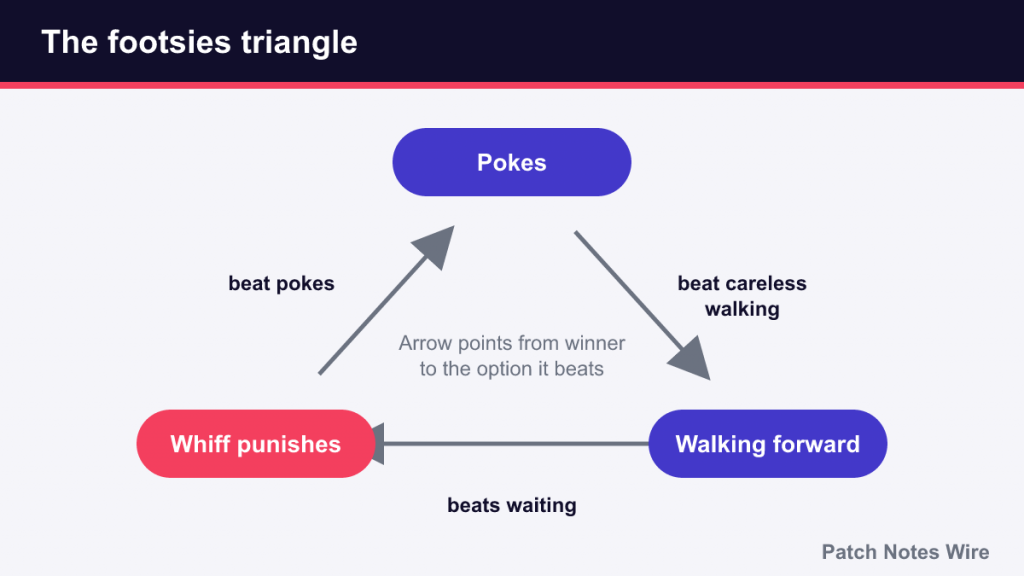
The “footsies triangle”
A simplified way to think about mid-range neutral is as three core actions that beat each other:
- Pokes (sticking out a normal) beat players who walk forward carelessly.
- Whiff punishes (waiting just outside range) beat pokes.
- Walking forward or committing to an advance beats players who sit back waiting to whiff punish, because it takes space away from them.
Real matches are more complicated than this, but the triangle captures the core tension.
Footsies in 2D vs 3D Fighters
2D games
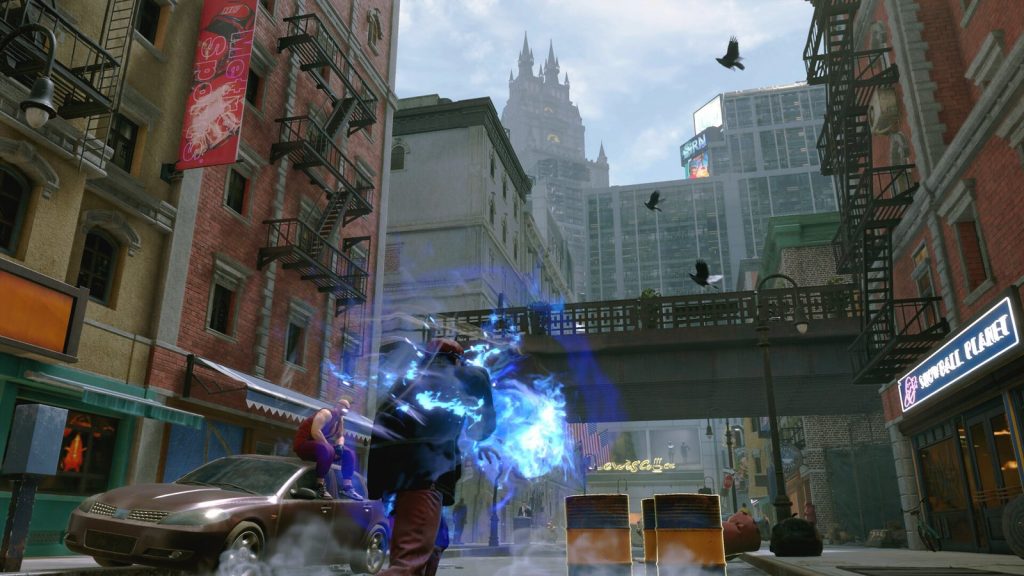
In Street Fighter and other traditional 2D fighters, footsies happens along a single horizontal line. The main defensive tools are walking back, blocking and jumping. Long-reaching normals, fireballs and special moves define how each character controls space. Modern Street Fighter games also add resources to neutral: Street Fighter 6’s Drive Rush, for instance, lets a player close distance very quickly from a canceled normal, which changes how far away “safe” really is.
Anime fighters
Games like Guilty Gear Strive have faster movement, airdashes and more aerial options, so neutral includes the air as much as the ground. The principles are the same (range, whiff punishing, risk), but the space being controlled is vertical as well as horizontal.
3D games
In Tekken and other 3D fighters, neutral adds a second axis. Sidesteps can make linear attacks miss, and backdashes let characters slide out of range. Tekken players often talk about “spacing” and “whiff punishing” in exactly the same terms as Street Fighter players, but the tools differ: instead of long pokes on a single line, players use quick mid attacks, sidesteps, backdashes and launchers that punish whiffed moves. The fundamental question is still the same: who can make the other player miss and then hit them.
Why Footsies Wins Matches
Strong neutral play has three big effects:
- It creates the first hit. Every combo starts with a successful hit, and most of those come out of neutral.
- It controls the screen. In 2D games, winning neutral steadily pushes the opponent toward the corner, where they have fewer options.
- It drains resources. In games with meters like Street Fighter 6’s Drive Gauge, being forced to block pokes or spend meter to escape eventually leaves the opponent with fewer options.
It also has a psychological effect. A player who keeps getting hit by pokes often becomes hesitant, which opens them up to more aggressive approaches.
Common Mistakes
- Throwing out pokes at random. Pokes are a tool to control specific ranges, not a default action. If your poke cannot reach, it only gives the opponent a free whiff punish.
- Standing still. Many beginners stay at one range and wait. Small movements forward and back are part of footsies, and they make your opponent’s pokes harder to time.
- Jumping too much. Jumping beats grounded pokes but loses badly to anti-airs. A predictable jumper gives the opponent an easy read.
- Ignoring the opponent’s best normals. Learn the reach of the opposing character’s key pokes. Many neutral wins come from simply staying just outside them.
- Chasing combos at the expense of neutral. A long combo you can rarely start is worth less than a short one that comes off a reliable poke.
Practice Drills
Learn your ranges
In training mode, find the maximum range of your two or three most important normals. Stand at that distance and practise walking in and out of it. Many games let you display hitboxes or position markers, which helps.
Whiff punish drill
Set the training dummy to perform a poke repeatedly (most games allow you to record and loop an action). Stand just outside its range and practise punishing the recovery with your own fast, long-reaching normal. Then increase difficulty by having the dummy alternate between poking and walking forward.
Buffering drill
Practise inputting a special move during your poke so that it cancels automatically on hit. Start slowly and focus on consistency rather than speed. Our notation guide explains how these inputs are written if you want to follow community resources.
A dedicated teaching game
FOOTSIES, a small 2D fighter created by HiFight and first released in 2018, strips the genre down to almost nothing but spacing, hit confirms and whiff punishes. Its Rollback Edition, released on Steam in September 2020, includes training mode, a hitbox viewer, frame data in the command list and dedicated hit confirm and whiff punish minigames. Because each character has only a handful of moves, it isolates exactly the skills this article describes.
How to Tell If You Are Improving
Neutral is harder to measure than combos, but there are signs. Watch your replays and ask: who landed the first hit in each round, and how? Were you hit by the same poke repeatedly? Did you whiff moves that the opponent punished? Over time you should see fewer random hits and more deliberate ones. You will also notice that your combos start more often from pokes and whiff punishes and less from lucky scrambles.
Footsies is a lifelong skill. Top players are still refining it after many years, and every new game shifts the details. But the core idea never changes: control the space, make the opponent miss, and punish them for it.