Devil May Cry Series Guide: Play Order and Where to Start
Every mainline Devil May Cry game plus DmC, in release and story order, with the collections and remasters to use and the best entry point for newcomers.
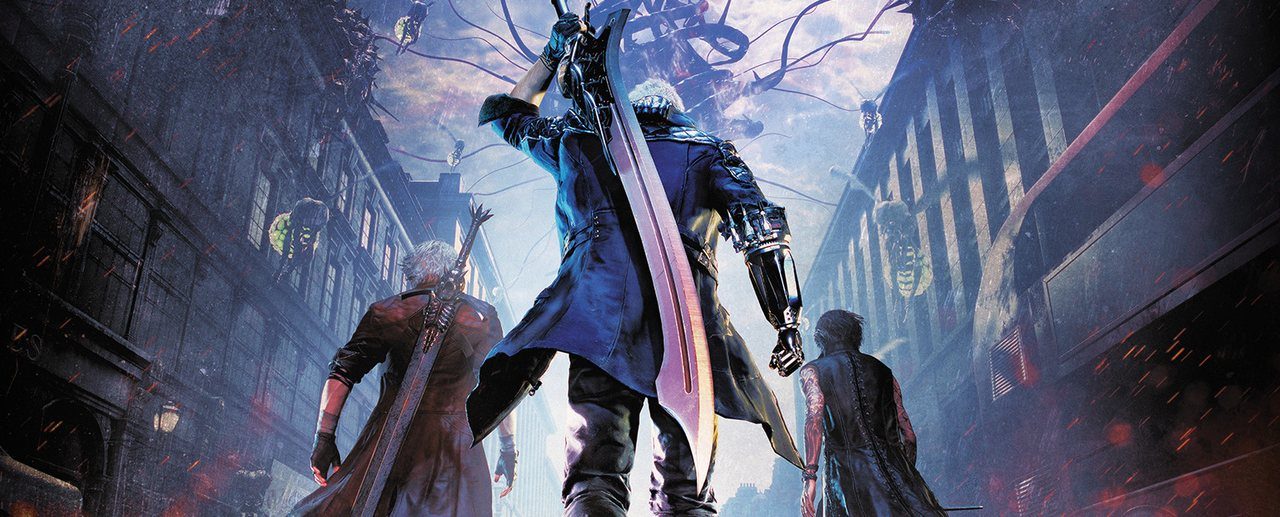
Devil May Cry has been running for 25 years, as of 2026, and the order of its games does not match its story. The third game is a prequel. The fourth was later placed after the second. There is also a 2013 reboot that sits outside the main timeline completely. Throw in HD collections, Special Editions and a Switch 2 release of the fifth game, and you can see why new players ask where they should start.
Below you’ll find every mainline game, the reboot, release order and story order, the versions worth buying today and a short take on what each entry adds to the combat. The answer to “where do I start?” comes at the end, and it is less obvious than you might expect.
The Mainline Games at a Glance
Capcom’s main series has five numbered games, and Hideki Kamiya’s original design started what is now called the character action genre. Here they are in release order, with their first platforms and the later versions that matter most:
| Game | Original release | Original platforms | Notable later versions |
|---|---|---|---|
| Devil May Cry | 2001 | PlayStation 2 | HD Collection (2012, re-released 2018); Switch (2019) |
| Devil May Cry 2 | 2003 | PlayStation 2 | HD Collection; Switch (2019) |
| Devil May Cry 3: Dante’s Awakening | 2005 | PlayStation 2 | Special Edition (2006, PS2 and PC); HD Collection; Switch (2020) |
| Devil May Cry 4 | 2008 | PS3, Xbox 360, PC | Special Edition (2015) |
| DmC: Devil May Cry (reboot) | 2013 | PS3, Xbox 360, PC | Definitive Edition (2015, PS4 and Xbox One) |
| Devil May Cry 5 | 2019 | PS4, Xbox One, PC | Special Edition (2020, PS5 and Xbox Series X|S); Devil Hunter Edition (2026, Switch 2) |
The series also has spin-offs. Mobile releases include Devil May Cry: Peak of Combat, which launched in China in 2021 and worldwide in January 2024, and there were smaller feature-phone games in the 2000s. Neither belongs on a play-order list. Netflix’s animated series premiered in April 2025 and its second season arrived in May 2026. It’s a good companion, but you don’t need it to follow the games.
Release Order vs Story Order
Release order is simply the list above. Story order rearranges it:
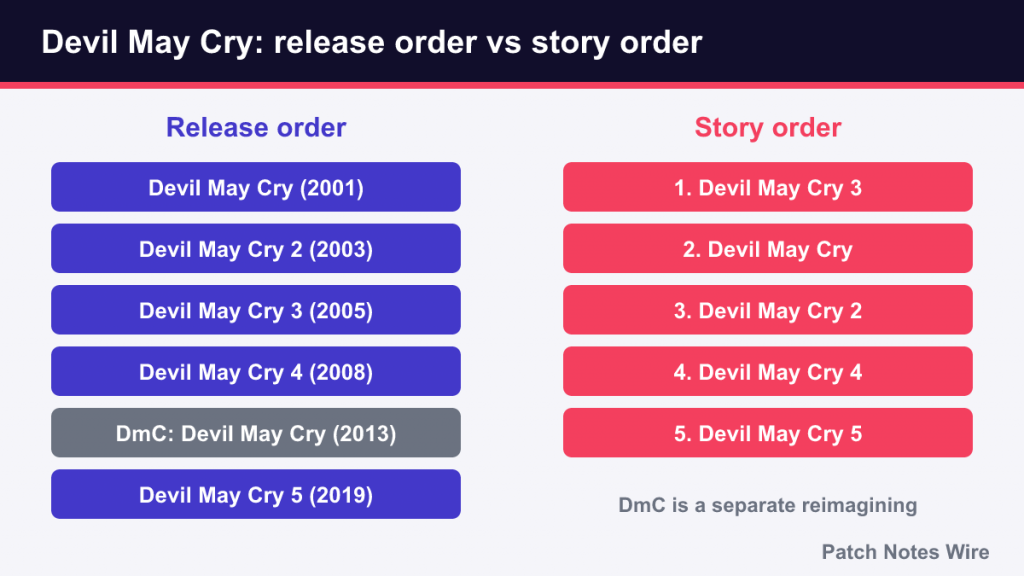
- Devil May Cry 3: Dante’s Awakening: a prequel set years before the first game. A young Dante faces his twin brother Vergil.
- Devil May Cry: Dante goes to Mallet Island to confront the demon emperor Mundus, the foe his father Sparda sealed away long ago.
- Devil May Cry 2: Dante helps Lucia and Matier against Arius.
- Devil May Cry 4: Nero is introduced, along with the Order of the Sword and its leader Sanctus. The game is now placed after DMC2.
- Devil May Cry 5: set several years after DMC4, with Nero, Dante and the mysterious V.
DmC: Devil May Cry is not in this list at all. Ninja Theory developed it as a reimagining, with its own version of Dante, its own Vergil and a different world, so you can play it whenever you like.
Should you play in story order? It does no harm, but release order is the better choice for most players. The mechanics improve from one release to the next, and going from DMC3 back to DMC1 and DMC2 can feel stiff once you’ve had DMC3’s toolset.
What Each Game Brings to the Combat
Devil May Cry (2001)
The first game set the template: a sword and a pair of guns used together, juggling enemies in the air, a Devil Trigger transformation that boosts power, and a style meter that grades your fighting as you go. The camera is fixed and the level design is close to survival horror, since it started as an early concept for Resident Evil 4. It’s short, tough and still worth playing.
Devil May Cry 2 (2003)
DMC2 has the weakest reputation in the series. Enemies are less aggressive, the levels are emptier, and guns can carry you through much of the game. It added a second playable character, Lucia.
Devil May Cry 3: Dante’s Awakening (2005)
DMC3 is where the series found its identity. It introduced the Style system, in which Dante picks one of four styles. Trickster is for evasion and movement, Swordmaster adds melee techniques, Gunslinger expands gunplay and Royalguard blocks and stores energy for counterattacks. Quicksilver and Doppelganger unlock later. The game also has many weapons to switch between, and the difficulty is notoriously high in the original North American release. The Special Edition made Vergil playable and adjusted the difficulty settings. The Switch version, released in February 2020, lets Dante switch freely between all styles and weapons in the middle of a fight.
Devil May Cry 4 (2008)
DMC4 introduced Nero, whose Devil Bringer arm pulls enemies to him or pulls him to them and performs context-sensitive throws. His Red Queen sword has an Exceed gauge that you can charge with precisely timed button presses. Dante returns for the second half with real-time style switching, which completely changed what high-level Dante play looks like. The 2015 Special Edition added Vergil, Lady and Trish as playable characters, along with a Legendary Dark Knight mode with crowded enemy encounters and other extras.
DmC: Devil May Cry (2013)
Ninja Theory’s reboot replaced the Style system with angel and demon weapon sets, assigned to modifier triggers, plus grappling hooks that pull you toward enemies or enemies toward you. The original release was criticized for its default 30fps on consoles and for being easy to rank highly in. The 2015 Definitive Edition, released for PS4 and Xbox One, raised the frame rate to 60fps, included all the DLC, and added modes and tuning aimed at experienced players. Of the two, the Definitive Edition is the one to play.
Devil May Cry 5 (2019)
DMC5 moved the series to Capcom’s RE Engine and split the campaign across three characters. Nero uses Devil Breakers, prosthetic arms with different abilities that can break if you are hit. Dante has four styles, several melee weapons and guns, and enough tools to fill dozens of hours of practice. V fights through summoned familiars and finishes enemies himself, an unusual “puppet” style of play for the genre. The 2020 Special Edition arrived on PS5 and Xbox Series X|S as a launch title and made Vergil playable, along with a Legendary Dark Knight mode and an optional Turbo mode. Owners of the original release on PS4, Xbox One or PC could buy Vergil as DLC. In June 2026, Capcom released Devil May Cry 5: Devil Hunter Edition on Nintendo Switch 2, the game’s first appearance on a Nintendo console.
Which Versions to Buy in 2026
Because almost every game has a later version, the right edition matters. These recommendations are current as of October 2026:
- Devil May Cry HD Collection includes DMC1, DMC2 and DMC3 Special Edition. It first came out in 2012 for PS3 and Xbox 360 and was re-released in March 2018 for PS4, Xbox One and PC. This is the simplest way to own all three classic games on current hardware.
- Nintendo Switch ports of DMC1, DMC2 and DMC3 were released individually between 2019 and 2020. The DMC3 Switch port is worth noting because of its free style switching and local co-op in Bloody Palace.
- Devil May Cry 4: Special Edition (2015) replaced the original release on newer platforms and is the version to get for the three extra playable characters.
- DmC: Devil May Cry Definitive Edition (2015, PS4 and Xbox One) is better than the original 2013 release in almost every way.
- Devil May Cry 5: on PS5 or Xbox Series X|S, buy the Special Edition. On PC, PS4 or Xbox One, add the Vergil DLC to the base game. On Switch 2, the Devil Hunter Edition is the only option.
Before buying, check each store page for the current platform list and exact contents. Capcom has re-released these games several times, and bundles change.
Where Should a Newcomer Start?
There are three sensible starting points, depending on what you want.
Start with Devil May Cry 5 if you want the smoothest introduction
For most new players in 2026, DMC5 is the best entry point. It has a modern camera, clear tutorials, a gentle Human difficulty and three characters who introduce the series’ ideas one at a time. Nero’s early missions are especially approachable. The story gives enough recap that you will know who everyone is.
Start with Devil May Cry 3 if you want the classic experience
DMC3 is the oldest game that still plays very well, and it is the first chapter of the story. Its difficulty can be a wall, though. Pick the easiest available setting the first time, and expect some bosses to take several attempts. If you finish it, DMC1 makes sense as a direct sequel and DMC4 and DMC5 will feel like natural progressions.
Start with DmC if you want a standalone game
DmC: Definitive Edition is self-contained. It works well for players who want a single game with tight pacing and an easy-to-learn moveset, and who do not care about the original continuity. It is not, however, a substitute for the mainline story.
A Suggested Play Order
For a complete run, this order balances story, mechanics and fun:
- Devil May Cry 5: learn the basics with the most comfortable game.
- Devil May Cry 3 Special Edition: go back to the start of the story and see how the Style system began.
- Devil May Cry: the direct sequel to DMC3 in story terms, and the game that started it all.
- Devil May Cry 4 Special Edition: Nero’s introduction and the setup for his arc in DMC5.
- Devil May Cry 2: optional, for completionists.
- DmC: Definitive Edition: whenever you want something different.
This order has one cost: playing DMC5 first reveals some things about Nero’s past and Dante’s family that DMC3 and DMC4 build toward. If spoilers matter more to you than comfort, play DMC3, DMC1, DMC4 and then DMC5, adding DMC2 between DMC1 and DMC4 if you want everything in story order.
Tips for Getting Into the Series
- Don’t worry about the style meter on your first run. The D-to-SSS grade is fun, but finishing a mission matters more than its grade at first. Our follow-up guide to style rankings explains how the grading works.
- Replay missions. Every game lets you go back to earlier missions with upgrades unlocked. That’s how the series expects you to improve.
- Use the training areas. DMC5’s Void mode lets you practice against chosen enemies, and it’s the easiest way to learn one combo at a time.
- Play higher difficulties once you feel ready. Harder settings change enemy behavior and placement.
If you are coming to Devil May Cry from fighting games, much of it will feel familiar: cancels, juggles, timing-based defense and a focus on execution. If you’re going the other way and want to try something head-to-head, our guide on how to choose your first fighting game covers the major options.
One Series, Many Doors
Devil May Cry doesn’t have a single correct starting point, and that’s part of its charm. DMC5 is the friendliest, DMC3 is the historical heart and DmC is the easy standalone detour. Whichever door you pick, the series rewards the same thing in every entry: going back to a fight you already beat and doing it with more style.