Super Smash Bros. Ultimate as a Fighting Game: Competitive Basics
How Smash Ultimate works as a competitive fighter: percent and knockback, stocks, shields and out-of-shield options, ledge play and tournament rules.
Super Smash Bros. Ultimate, released on Nintendo Switch in December 2018, is many things: a party game, a celebration of gaming history and one of the best-selling fighting games ever made. It is also a serious competitive fighting game with a large tournament scene. But if you come to it from Street Fighter or Tekken, almost nothing works the way you expect. There are no health bars, no motion inputs for most characters and no fixed stage boundaries. This guide explains how Smash works as a fighting game, what the standard competitive settings are and which fundamentals matter most.
How Smash Differs From Traditional Fighters
Percent instead of health
Instead of a health bar that empties, each character has a damage percentage that starts at 0% and rises as they get hit. The higher the percent, the further they fly when hit by a strong attack. You do not lose by running out of health; you lose a life (a stock) by being knocked off the screen past the stage’s blast zones.
Knockback and kill moves
Every attack has knockback that scales with the target’s percent. At low percent, most attacks keep the opponent close, which is when you build damage with combos. At high percent, strong attacks (often smash attacks, certain aerials and special moves) launch the opponent far enough to KO them. Much of Smash strategy is about building percent and then landing a “kill move” at the right moment.
Stocks
Each player has a number of lives. Lose them all, and you lose the game. Stocks change the pacing: a single good read at high percent can take a stock no matter how the previous minutes went.
Platforms and stages
Smash stages are platforms floating over an abyss, often with smaller platforms above. Movement is free in two dimensions, with multiple jumps, air dodges and recovery moves. There is no “corner” in the traditional sense; instead, the edge of the stage is the most important area.
Simplified inputs
Most special moves are performed with a single button plus a direction. This makes Smash easier to start, but the depth comes from movement, spacing and timing. A few characters taken from traditional fighting games (Ryu, Ken, Terry and Kazuya) can also use command inputs like quarter circles, which produce stronger or faster versions of their specials.
The Standard Competitive Ruleset
There is no single official ruleset for competitive Smash Ultimate; each tournament publishes its own. That said, most events use very similar settings:
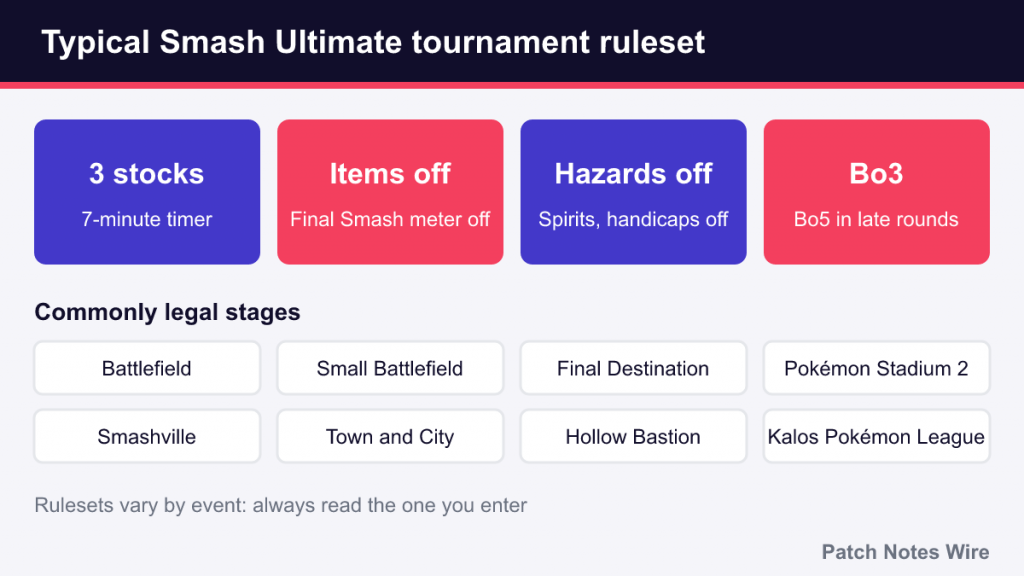
- Stocks and time: 3 stocks with a 7-minute timer is the most common setting. If time runs out, the player with more stocks (or, if tied, lower percent) usually wins.
- Items: off.
- Final Smash meter: off.
- Stage hazards: off.
- Spirits and handicaps: off.
- Format: sets are usually best-of-three, with later rounds of large events moving to best-of-five.
Legal stages
Stages are chosen from a short list of competitively balanced options. Commonly legal stages include Battlefield, Small Battlefield, Final Destination, Pokémon Stadium 2, Smashville, Town and City, Hollow Bastion and Kalos Pokémon League, though the exact list and which stages are “starters” vary by tournament. Stages are split into starters (available for game one) and counterpicks (available in later games).
Stage striking and counterpicks
For game one, players typically decide who strikes first (often with rock-paper-scissors) and then take turns banning stages from the starter list until one remains. After each game, the loser usually picks the next stage after the winner bans a number of stages. Some events also use a rule preventing a player from returning to a stage they have already won on in the set. Character selection order also matters: in many rulesets, after game one, the winner of the previous game selects their character first, letting the loser counterpick.
Always read the specific ruleset of the event you enter; the details vary more in Smash than in most other fighting game communities.
Shields, Grabs and Out-of-Shield Options
Shielding
Instead of holding back to block, Smash uses a bubble-like shield activated by a button. The shield shrinks while held and when hit, and it slowly regenerates when not in use. If it is depleted completely, it breaks, leaving the character stunned and helpless for a dangerous amount of time.
Parrying
Ultimate includes a parry: releasing the shield at the right moment just before an attack hits deflects it and gives the defender a window to counter. It is a high-skill technique with strong rewards.
Grabs
Grabs beat shields. A grabbed opponent can be thrown in four directions, and some throws lead into combos or kill at high percent. This creates a basic mix-up loop: attacks beat grabs (if timed to hit before the grab), shields beat attacks, and grabs beat shields.
Out-of-shield options
Because shields block everything except grabs, attacks that hit a shield need to be safe. Defending players look for out-of-shield options: actions you can perform quickly from shield to punish an attacker. Common ones include:
- Shield grab: grabbing directly out of shield.
- Jump out of shield into an aerial: jumping cancels the shield, allowing a quick aerial attack.
- Up special or up smash out of shield: these can be used directly from shield in Ultimate, making them fast punishes.
- Shield drop: letting go of the shield to move or attack.
Learning which of your moves are safe on shield, and what your character’s best out-of-shield punish is, is the Smash equivalent of learning which moves are punishable in other games. Our frame data guide covers the general logic, which applies to Smash too.
Ledge Play and Edgeguarding
The edge of the stage is the most important area in competitive Smash.
Recovering
When knocked off-stage, you use double jumps, air dodges and recovery moves (usually up special) to return. Most characters grab the ledge as part of their recovery. Mixing up how you return (high, low, directly to the stage, or to the ledge) makes you harder to intercept.
Edgeguarding
Edgeguarding is the art of stopping the opponent’s recovery. You might go off-stage to hit them with an aerial, wait at the ledge with a move that covers their recovery path, or grab the ledge yourself so they cannot. Strong edgeguarding can take stocks at very low percent, which is why it is one of the highest-reward skills in the game.
Ledge options
Once a player is hanging on the ledge, they have several ways to get up: normal getup, getup attack, roll, ledge jump, or dropping and jumping back with an aerial. The opponent on stage tries to cover these options. Ledge play has its own subtleties, such as ledge invincibility that changes depending on how often you grab the ledge, and taking the ledge from a player who is already on it (“ledge trapping” and “trumping”).
Movement, DI and Survival
Movement
Smash rewards precise movement: short hops (a quick tap of jump for a small hop), fast-falling, dashing and pivoting. Much of neutral in Smash is about controlling space with safe aerials, much like poking in traditional fighters.
Directional Influence
When you are launched, you can influence the angle of your knockback by holding a direction. This is directional influence (DI). Good DI can help you survive hits that would otherwise KO you, or escape combos. It is one of the most important defensive skills, and many beginners overlook it entirely.
Recovery and survival
Surviving at high percent through good DI, smart recovery and careful positioning is as important as landing kill moves. Many games are decided by one player surviving a hit that should have KO’d them.
Common Beginner Mistakes
- Over-using smash attacks. They are slow and punishable; use them as punishes or reads, not neutral tools.
- Rolling too much. Rolls are predictable and easy to punish.
- Recovering the same way every time. It makes edgeguarding easy.
- Holding shield too long. Opponents will grab you or break your shield.
- Ignoring DI. It is the difference between surviving and losing stocks early.
- Playing on item-heavy casual settings and expecting the same habits to work competitively. The competitive game is a different experience.
A Simple Practice Plan
Smash’s training mode is more limited than those of traditional fighters, but it still covers the essentials. A practical routine for a new competitive player:
- Movement first. Practise short hops, fast-falling and landing aerials on the stage until each one comes out on purpose. Clean movement makes every other skill easier.
- Learn your safe aerials. Find out which of your aerials can hit a shield without leaving you open to a grab, and which ones should only be used as punishes.
- Find your out-of-shield punish. Have a friend or a CPU attack your shield, and practise your fastest option out of it until it is automatic.
- Drill recovery. Get knocked off-stage from different angles and practise returning by different routes: high, low and to the ledge.
- Learn one edgeguard. Pick one reliable way to cover the opponent’s most common recovery and practise it until you can do it under pressure.
After that, watch your own matches. Smash rewards spotting habits: how you get up from the ledge, when you roll, how you recover. Opponents will learn these patterns quickly, so you should know them first.
Smash and the Wider Fighting Game Community
Smash has a long competitive history and a scene that grew partly independently of traditional fighters. Its relationship with Nintendo has had ups and downs; most notably, Nintendo published Community Tournament Guidelines in October 2023, effective from November 2023, which set limits on unlicensed events, including caps on participants, entry fees and prize value. Larger events operate with a license from Nintendo.
Whether Smash is a “real fighting game” is a long-running debate, but in practical terms its competitive scene uses the same core skills as any fighter: spacing, punishing, reading habits and adapting. If you are trying to decide between Smash and a traditional fighter as your first competitive game, our guide on how to choose your first fighting game compares the options.