Fighting Game Glossary: 60 Terms Every New Player Should Know
Sixty essential fighting game terms in plain English, from anti-air and footsies to okizeme, frame traps and whiff punishes, each with a quick example.
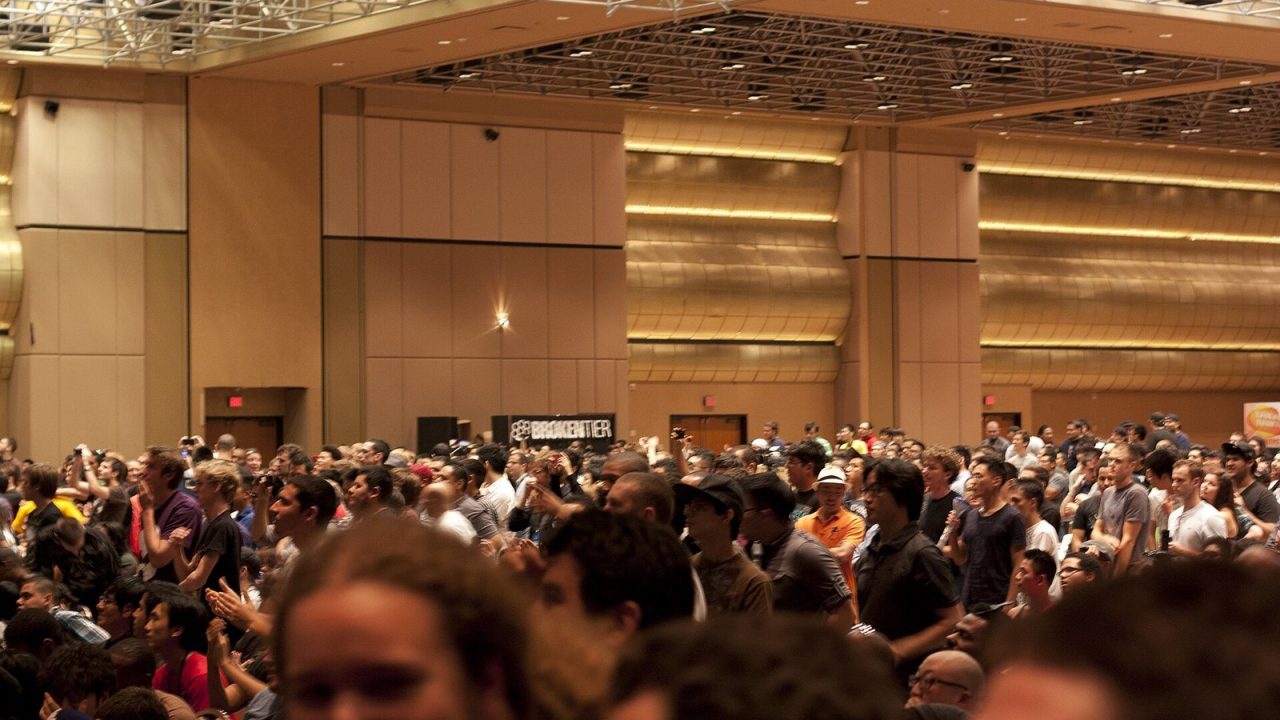
Fighting game communities talk fast. Watch a tournament stream or read a character guide and you will hear that someone “got a meaty into a frame trap off the hard knockdown” or “shimmied the tech and whiff punished.” This glossary translates the 60 terms you are most likely to meet, in alphabetical order, with a plain-English definition and a short example for each. The terms apply across most games, from Street Fighter and Tekken to Guilty Gear and Mortal Kombat, though individual games sometimes add their own twist.
If you also need help reading combo strings like 2MK xx 236HP, start with our guide to fighting game notation. Many of the terms below involve timing, which is covered in detail in frame data explained.
A to C
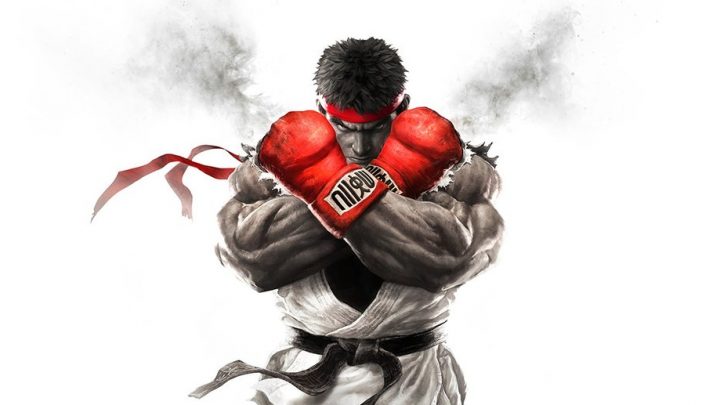
1. Anti-air — An attack used to hit an opponent who is jumping at you. Example: Ryu’s Shoryuken or a crouching heavy punch timed against a jump-in.
2. Armor — A property that lets a move absorb one or more hits without being interrupted, usually while still taking some damage. Example: Street Fighter 6’s Drive Impact absorbs hits during its startup.
3. Blockstun — The short period after blocking an attack during which the defender cannot act. Example: a heavy attack causes longer blockstun than a light one.
4. Buffer — Entering an input early so the game stores it and executes it at the first possible moment. Example: doing the fireball motion during a crouching kick so the fireball comes out as a cancel.
5. Cancel — Interrupting one move’s animation with another, skipping its recovery. Example: canceling a crouching medium kick into a special move.
6. Charge character — A character whose specials require holding a direction for a moment before pressing the opposite one. Example: Guile holding back to charge Sonic Boom.
7. Chip damage — Small damage taken while blocking, usually from specials and supers. Example: finishing a low-health opponent with a blocked super.
8. Combo — A sequence of hits the opponent cannot escape once the first one lands. Example: light punch, light punch, special move.
9. Conditioning — Teaching your opponent to expect a pattern, then breaking it. Example: throwing several times in a row, then attacking the player who now expects a throw.
10. Corner — The edge of the stage, where the trapped player cannot back away. Example: most characters have stronger pressure and combos in the corner.
11. Counter hit — Hitting an opponent while they are in the startup of their own attack, often granting extra damage or advantage. Example: a poke that becomes a combo starter only on counter hit.
12. Cross-up — An attack that hits from behind or switches which side the opponent must block. Example: a jumping kick landing just behind a crouching opponent’s head.
D to H
13. DP — Short for “Dragon Punch,” a rising attack with invincibility on startup and long recovery. Example: Shoryuken; also used for the 623 motion itself.
14. Footsies — The mid-range battle over space, using pokes, walking and whiff punishes. Example: two players walking in and out of each other’s crouching medium kick range.
15. Frame — The smallest unit of game time, one-sixtieth of a second in most modern fighters. Example: a 4-frame jab hits about 67 milliseconds after pressing.
16. Frame advantage — Who recovers first after an attack connects, expressed as plus or minus. Example: a move that is +2 on block lets you act 2 frames earlier.
17. Frame trap — A deliberate small gap between attacks that catches an opponent who tries to press a button. Example: a plus-on-block light punch followed by a slightly delayed medium.
18. Gatling — A chain of normals canceled into each other, a term from Guilty Gear. Example: close slash into crouching heavy slash.
19. Grappler — An archetype built around command throws, often slow with high health. Example: Zangief and his Spinning Piledriver.
20. Hard knockdown — A knockdown the defender cannot quickly recover from, giving the attacker time to set up. Example: a sweep in older Street Fighter games.
21. High and low — Attack heights. Lows must be blocked crouching; overheads standing; mids standing in Tekken. Example: sweeps are lows.
22. Hit confirm — Starting a combo and only continuing if the first hits land, instead of committing blindly. Example: two light punches, then a super only if they hit.
23. Hitbox — The invisible area of an attack that can hit the opponent. Example: a sword swing in Guilty Gear has a large hitbox.
24. Hitstun — The period after being hit when a character cannot act, which is what makes combos possible. Example: more hitstun means more time to link the next attack.
25. Hurtbox — The area of a character that can be hit. Example: a crouching character has a smaller hurtbox, so some attacks whiff over them.
I to M
26. Invincibility — Frames during which a character cannot be hit by some or all attacks. Example: the startup of a DP.
27. Juggle — Hitting an airborne opponent repeatedly before they land. Example: Tekken combos after a launcher.
28. Kara cancel — Canceling a move almost immediately into another to borrow its movement or range. Example: kara throws in Street Fighter III.
29. Knockdown — Putting the opponent on the floor. Example: most combos end in a knockdown, starting the wakeup game.
30. Link — Connecting two moves in a combo by waiting for the first to recover. Example: a +4 on hit move linking into a 4-frame jab.
31. Mashing — Pressing buttons rapidly, often at the wrong time. Example: mashing jab during blockstun and getting caught by a frame trap.
32. Meaty — An attack timed so its later active frames overlap the opponent’s wakeup. Example: a crouching medium kick timed to hit as they stand.
33. Meter — A resource bar that powers supers and enhanced moves. Example: Street Fighter 6’s Super Art gauge.
34. Mix-up — A situation that forces the opponent to guess between options. Example: an overhead versus a low, or a left versus right cross-up.
35. Motion input — A special move command built from joystick movements. Example: a quarter circle forward (236) for a fireball.
N to R
36. Negative edge — Some games register a button release as a press, helpful for certain special inputs. Example: holding punch and releasing it to finish a motion.
37. Neutral — The part of a match when neither player has an advantage. Also the joystick at rest (5 in numpad). Example: the start of every round.
38. Okizeme (oki) — Japanese term for offense on a knocked-down opponent as they wake up. Example: a meaty attack or throw setup after a knockdown.
39. Option select — A single input that produces the right response to several possible situations. Example: an input that blocks if the opponent attacks and techs if they throw.
40. Overhead — An attack that must be blocked standing. Example: Ryu’s forward plus medium punch.
41. Plus on block — A move that leaves the attacker with frame advantage even when blocked. Example: a plus jab lets you keep attacking.
42. Poke — A quick, low-risk normal used to control space. Example: a far-reaching crouching medium kick.
43. Pressure — Continuous attacking that keeps the opponent blocking. Example: mixing safe strings with throws on a cornered opponent.
44. Punish — Hitting an opponent during the recovery of their unsafe move. Example: a full combo after blocking a DP.
45. Reversal — An attack done on the first possible frame after blockstun or wakeup, usually invincible. Example: a wakeup DP.
46. Rushdown — An aggressive play style focused on close-range offense. Example: a fast character constantly dashing in.
S to Z
47. Safe jump — A jump-in timed so you land in time to block an opponent’s reversal. Example: jumping on a knocked-down opponent who often uses a wakeup DP.
48. Scaling — Damage reduction applied to each later hit in a combo. Example: why adding more hits gives diminishing returns.
49. Shimmy — Walking back just out of range to bait a throw tech or button press, then punishing it. Example: stepping back as the opponent tries to tech a throw, then hitting the whiffed throw.
50. Shoto — An archetype based on Ryu and Ken, with a fireball, a DP and a forward-moving special. Example: Ryu, Ken, Akuma.
51. Spacing — Controlling the distance between characters. Example: using a move at max range so it is hard to punish.
52. Special move — A command move beyond basic normals, usually a motion input. Example: Hadoken.
53. Startup — The frames before an attack can hit. Example: a 4-frame light punch starts much faster than a 20-frame heavy.
54. Super — A powerful move that costs meter. Example: Street Fighter 6 Super Arts or Tekken 8 Rage Arts.
55. Tech — Escaping a throw or recovering quickly from a knockdown or air hit by pressing buttons. Example: pressing throw as the opponent grabs you.
56. Throw — An unblockable close-range grab that beats blocking. Example: light punch plus light kick in Street Fighter 6.
57. Tick throw — A light attack followed quickly by a throw, catching an opponent who keeps blocking. Example: a blocked jab, then a step forward and throw.
58. Wakeup — The moment a knocked-down character stands up. Example: choosing between blocking, a reversal or teching on wakeup.
59. Whiff punish — Hitting the opponent during the recovery of an attack that missed. Example: stepping back from a poke and hitting its extended limb.
60. Zoning — Keeping the opponent away with projectiles and long-range attacks. Example: Guile throwing Sonic Booms from full screen.
How the Terms Fit Together
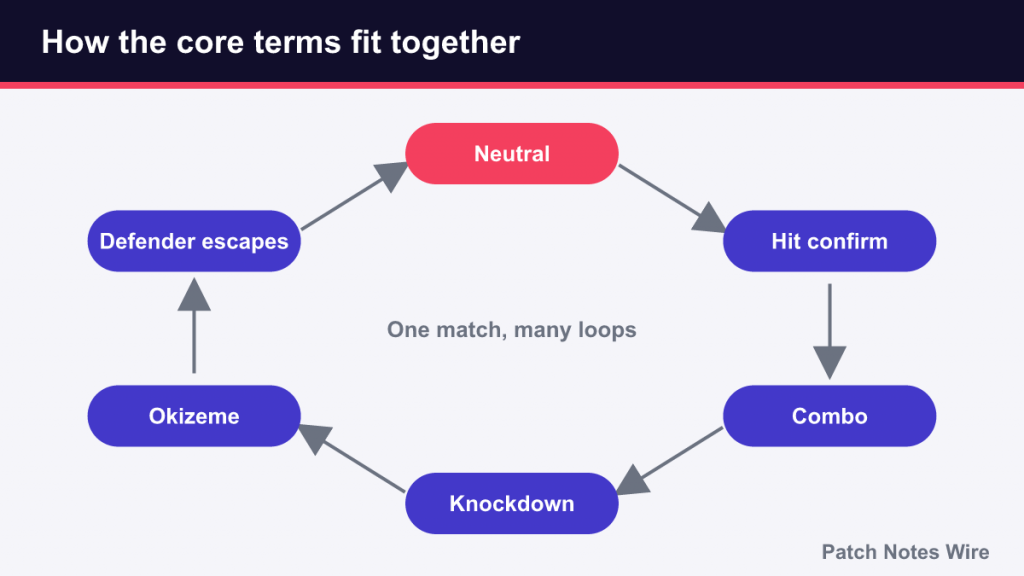
These words describe a cycle that repeats throughout every match. Neutral and footsies decide who lands the first hit. A hit confirm turns that hit into a combo, which ends in a knockdown. The attacker then runs okizeme with meaty attacks, throws and mix-ups, while the defender decides whether to block, tech, or risk a reversal. Once the defender escapes, the round returns to neutral.
A few common misunderstandings are worth avoiding. “Mix-up” does not mean any random attack; it describes a real guess between two or more options. “Frame trap” is not a combo, because the opponent can escape by blocking. “Safe” always depends on the opponent’s fastest punish and on spacing. And a “DP” is not just a Street Fighter move: many games give characters a similar invincible reversal under different names.
You do not need to memorize all 60 terms at once. Learn the vocabulary as each concept becomes relevant to your play, and use training mode to see each idea in action.