The History of Tekken: How Namco Built the 3D Fighter
From Tekken (1994) to Tekken 8: the sidestep, tag battles, Bound, Rage and Heat, the Mishima feud in brief, and Katsuhiro Harada's long run with the series.
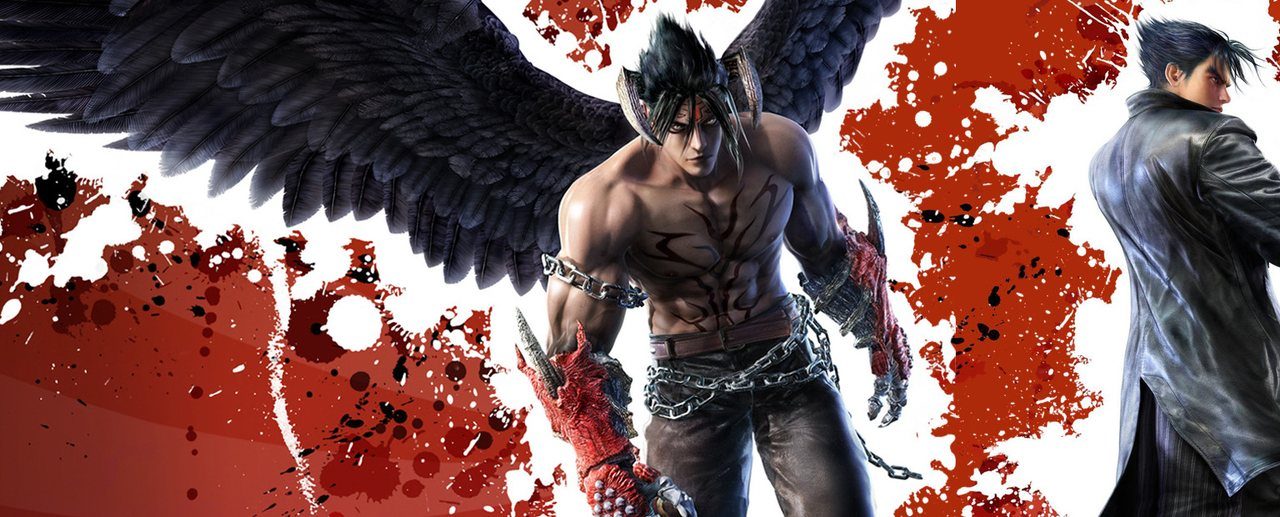
Tekken started as an arcade experiment in polygonal fighting and became one of the longest-running series in the genre. Over three decades it built a distinctive identity: four buttons mapped to limbs, a camera that lets fighters move around each other, punishing frame-perfect defense and a family feud that has been running since 1994. According to Bandai Namco figures reported on Wikipedia, the series had sold around 61 million units by March 2025.
This history follows the games in order, focusing on what each one changed about how Tekken is played.
The Foundation: Tekken and Tekken 2 (1994–1996)
The first Tekken launched in arcades in 1994 and on the original PlayStation in 1995. Namco’s arcade board for it was based on PlayStation hardware, which made the home port unusually faithful for the era and helped the game become an early showcase for Sony’s console.
Its central design idea is still the heart of the series. Instead of light, medium and heavy attacks, Tekken assigned one button to each limb: left punch, right punch, left kick and right kick. Pressing a button meant “use that arm or leg,” and character move lists were built from combinations of those limbs and directions. That mapping made it intuitive to understand what a move would look like, while giving each character a large vocabulary of strings, throws and stances.
Tekken 2 (1995 in arcades, 1996 on PlayStation) expanded the roster and refined the formula, adding more single-player content for the home version. Both games were still mostly fought along a single line: characters moved forward and back, and the 3D models did not yet translate into much 3D movement.
Tekken 3 and the Sidestep (1997–1998)
Tekken 3 (1997 in arcades, 1998 on PlayStation) is the entry most often credited with making Tekken a true 3D fighter. Its key addition was the sidestep: tapping up or down to step into the foreground or background. Suddenly, attacks were no longer just high, mid or low. They were also linear or tracking, and stepping around a linear attack became a way to make it whiff and punish it.
Tekken 3 also jumped the story forward by about two decades and introduced a new generation of characters, led by Jin Kazama, along with a lighter, faster feel and characters such as Eddy Gordo, whose capoeira style became a long-running point of debate among players. For many people who grew up with the PlayStation, Tekken 3 was the series’ high-water mark, and it remained the best-selling Tekken until Tekken 7 overtook it.
The sidestep remains the mechanic that separates Tekken from 2D fighters. Movement, rather than jumping, is the main way to create space and make opponents miss. That is why Tekken players talk about “backdashing” and “sidewalking” the way Street Fighter players talk about footsies.
Tag Battles, Walls and Experiments (1999–2005)
Tekken Tag Tournament (1999 in arcades, 2000 on PlayStation 2) let players pick two characters and switch between them, with the inactive partner recovering some health. It turned the whole roster into a sandbox and became a launch-window favorite for the PS2.
Tekken 4 (2001 arcades, 2002 home) is remembered as the most experimental entry. It introduced enclosed stages with walls, uneven terrain and the ability to switch positions with an opponent. Walls in particular had a lasting effect: pinning an opponent against one creates extra combo and pressure opportunities, and wall play is still central in Tekken 8. Tekken 4’s other experiments were more divisive among players.
Tekken 5 (2004 arcades, 2005 home) is widely remembered as a return to form, with a faster pace and a broad roster. Its update, Tekken 5: Dark Resurrection (2005), added character customization and ranked-style progression and was later ported to the PlayStation Portable.
Bound, Rage and the Big Rosters (2007–2012)
Tekken 6 (2007 arcades, with the Bloodline Rebellion update forming the 2009 console release) added two systems that shaped the next decade:
- Bound. Certain moves could smash an airborne opponent back toward the ground, putting them in a bounced state that allowed the combo to continue. Bound made juggles longer and more creative, and gave every character a combo-extension tool.
- Rage. When a character’s health dropped low, they entered Rage and dealt increased damage. It was Tekken’s first universal comeback mechanic.
Tekken Tag Tournament 2 (2011 arcades, 2012 home) brought back the tag format with a very large roster and deeper tag mechanics, including Tag Assault, which brought the partner in mid-combo, and Tag Crash, a defensive switch tied to Rage. It became a favorite among players who enjoyed long, creative combos.
Tekken 7: Power Crush, Rage Arts and Screws (2015–2017)
Tekken 7 launched in arcades in March 2015, received the Fated Retribution arcade update in 2016, and arrived on PlayStation 4, Xbox One and Windows on June 2, 2017. It became the best-selling entry in the series, with Wikipedia citing 12 million units as of July 2024.
Tekken 7 reworked the comeback and combo systems:
- Rage Art. Rage now unlocked a character-specific super attack that dealt heavy damage if it connected, at the cost of the Rage state.
- Rage Drive. Added in Fated Retribution, these were powered-up moves that also spent Rage, giving players an offensive alternative to a Rage Art.
- Power Crush. Special attacks that kept going through high and mid hits, giving characters a way to challenge pressure while still taking damage.
- Screw. The screw (often called a tornado) largely replaced Bound. It spins an airborne opponent to extend a combo, but it cannot be used for wall combos, which kept damage under control.
Fated Retribution also added Akuma from Street Fighter as a guest, complete with his own meter and some 2D-style tools such as air fireballs. Guest characters became a regular feature of the game’s later seasons. (For Akuma’s home series, see our history of Street Fighter.)
Tekken 7’s long post-launch support, with multiple seasons of characters and balance changes, kept it at the center of the competitive 3D scene for years before its successor arrived.
Tekken 8 and the Heat System (2024–)
Tekken 8 released on January 26, 2024, for PlayStation 5, Xbox Series X|S and PC. Built on Unreal Engine 5, it was designed around aggression, and its headline system is Heat:
- Each round, a character can enter Heat once, either with a Heat Burst or by landing one of their Heat Engager moves.
- While in Heat, characters gain enhanced properties, deal chip damage on block, and can spend Heat on a Heat Smash or a Heat Dash to extend pressure or combos.
- Recoverable health appears as a gray portion of the health bar after taking damage; attacking the opponent can win some of it back, rewarding players who stay aggressive.
Rage and Rage Arts remain, Power Crushes are still in the game, and walls are still a major source of damage. For newcomers, Tekken 8 added Special Style, a simplified control scheme for performing combos and key moves, and the Arcade Quest mode, a single-player story about joining a local arcade scene. Our Tekken 8 beginner guide explains these systems from a new player’s point of view.
Commercially, Bandai Namco announced in February 2025 that Tekken 8 had passed 3 million copies sold, reaching that milestone faster than Tekken 7.
The Mishima Saga in Brief
Tekken’s story has always been driven by one family. The short version:
- Heihachi Mishima, head of the Mishima Zaibatsu, throws his young son Kazuya off a cliff to test his strength. Kazuya survives, carrying the Devil Gene.
- Kazuya wins the first King of Iron Fist Tournament and throws Heihachi off the same cliff. Heihachi survives too, and the feud passes through each new game.
- Kazuya’s son, Jin Kazama, born to Jun Kazama, is introduced in Tekken 3 and inherits both the Devil Gene and the conflict.
- Tekken 7 framed itself as the conclusion of the Heihachi–Kazuya feud, ending with Kazuya throwing Heihachi into a volcano.
- Tekken 8 centers on the clash between Jin and Kazuya.
Around that core sit dozens of fighters with their own reasons to enter each tournament, from the Williams sisters to Yoshimitsu. For most players, the story is a backdrop to the fighting, but it has given the series a recognizable identity and many of its most memorable characters.
Katsuhiro Harada’s Role
No individual is more associated with Tekken than Katsuhiro Harada. He joined Namco in 1994 and moved onto the original Tekken team early in his career, even providing voice work for characters such as Yoshimitsu and Marshall Law in the first games. He went on to direct Tekken 3, Tekken 4 and Tekken 5, served as executive producer on Tekken 6 and Tekken Tag Tournament 2, and directed Tekken 7. Over the years he also became the public face of the series, known for his outspoken presence at tournaments and on social media.
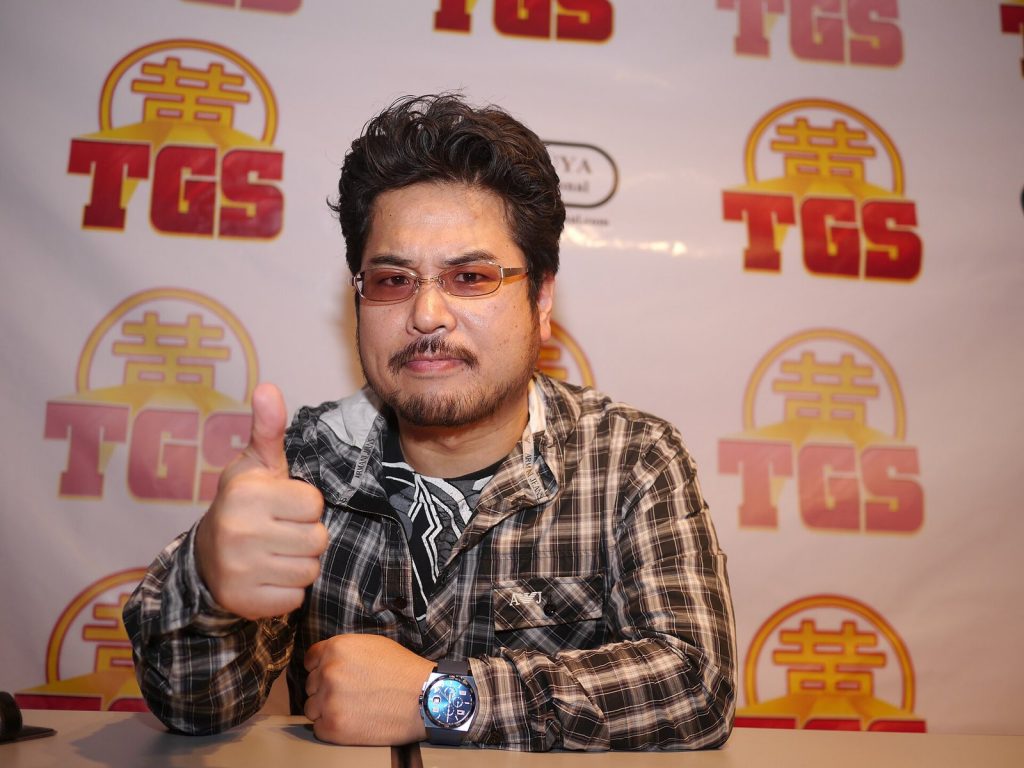
On December 8, 2025, Harada announced that he would leave Bandai Namco at the end of 2025, after roughly three decades with the company. He said he had been handing creative direction of Tekken to the current team for several years, and his final appearance as a Bandai Namco employee was at the Tekken World Tour Finals in early 2026. In May 2026, SNK announced a new subsidiary, VS Studio SNK, with Harada as its CEO. As of October 2026, Bandai Namco continues to develop Tekken 8 with the existing team.
What Tekken Gave the Genre
| Game | Arcade / home | Notable addition |
|---|---|---|
| Tekken | 1994 / 1995 | Limb-based four-button layout |
| Tekken 3 | 1997 / 1998 | Sidestep, new generation led by Jin |
| Tekken Tag Tournament | 1999 / 2000 | Two-character tag battles |
| Tekken 4 | 2001 / 2002 | Walls, uneven terrain, position switching |
| Tekken 6 | 2007 / 2009 | Bound, Rage |
| Tekken Tag Tournament 2 | 2011 / 2012 | Tag Assault, Tag Crash |
| Tekken 7 | 2015 / 2017 | Rage Art, Power Crush, Screw |
| Tekken 8 | 2024 (home) | Heat, recoverable health, Special Style |
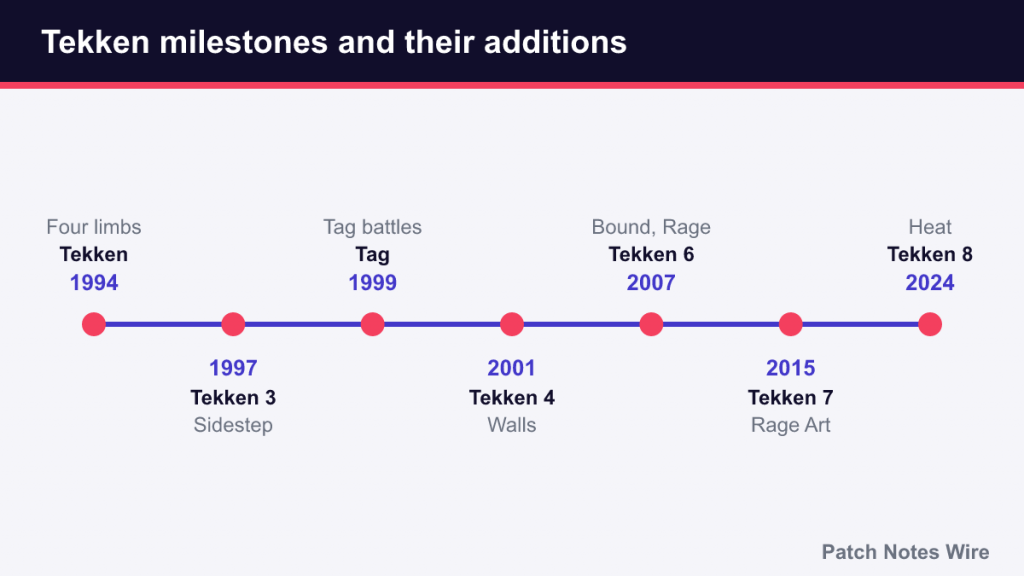
Looking down that list, the throughline is movement and momentum. The sidestep gave Tekken its 3D identity, walls gave positioning real stakes, and each new system from Bound to Heat has pushed the series toward longer and more aggressive offense, balanced by defense built on knowing what is punishable. Thirty years in, a Tekken match still comes down to the same question the 1994 original asked: which limb do you commit, and when?