Tekken 8 Beginner Guide: Heat, Rage and How to Start Learning
How Tekken 8 works for new players: limb buttons, Heat, Rage Arts, recoverable health, Special Style, Arcade Quest and a realistic order to learn it all.
Tekken has a reputation for being the fighting game you cannot simply pick up. Characters have huge move lists, the third dimension adds sidesteps and walls, and veterans have decades of muscle memory. Tekken 8, released on January 26, 2024 for PlayStation 5, Xbox Series X|S and PC, did not shrink the game, but it did add systems that reward aggression, a simplified control option and much better learning tools. The trick for a newcomer is knowing which parts matter on day one and which can wait for month three.
How Tekken’s Buttons Work: One Button per Limb
Most 2D fighters label buttons by strength: light, medium, heavy. Tekken labels them by limb. There are four attack buttons:
- 1 – left punch
- 2 – right punch
- 3 – left kick
- 4 – right kick
Directions are written relative to your character: f (forward), b (back), d (down), u (up), plus diagonals such as d/f. A move written as d/f+1 means down-forward plus left punch. Commas separate inputs pressed in sequence, so 1,2 is a quick jab followed by a right punch. If this notation is new to you, our guide to fighting game notation walks through it alongside the numpad system used in 2D games.
The limb layout matters because animations follow the button, and the same input often does something similar across characters. A d/f+1 is a quick mid punch for a large part of the cast, so learning one character makes the second easier.
Movement Is Part of the Controls
Tapping up or down sidesteps into or out of the background, and holding the direction turns the sidestep into a sidewalk. Double-tapping back performs a backdash, and double-tapping forward dashes in. Many attacks are linear, meaning they only travel straight ahead, and a well-timed sidestep makes them miss entirely. Others are homing or have tracking that catches sidesteps. Learning which is which comes later, but it helps to know from the start that walking sideways is a real defensive tool.
Blocking Highs, Mids and Lows
Holding back blocks standing attacks, and so does simply not pressing anything. Crouching (holding down or down-back) blocks lows and ducks under highs, but mid attacks hit crouching players. That is the core of Tekken defense: mids beat crouching, lows beat standing guard, and highs are fast but can be ducked. Because standing guard blocks both highs and mids, the safest default in Tekken is to stand and block, then react to lows when you can.
The Heat System Explained
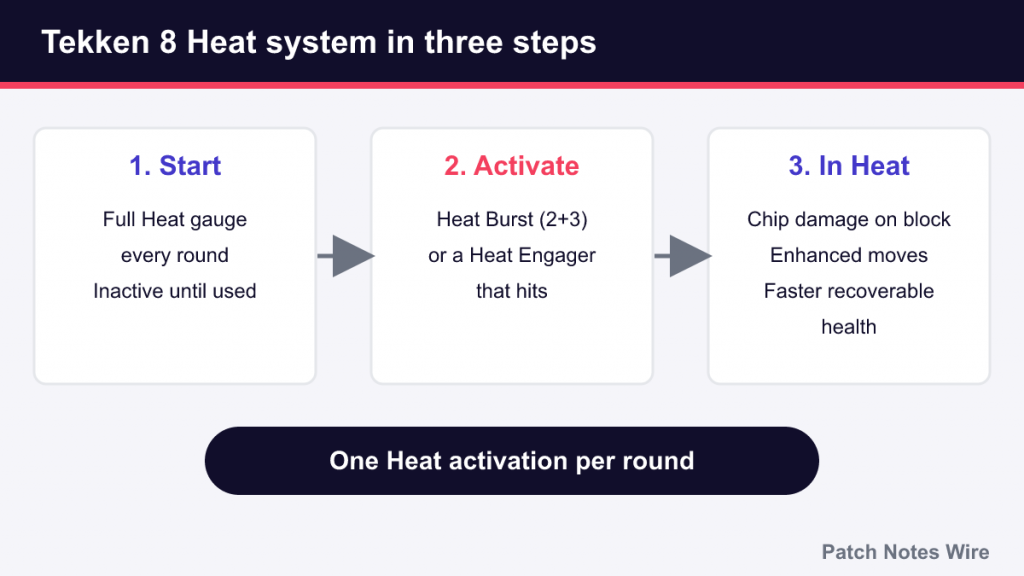
Heat is Tekken 8’s headline mechanic and the clearest sign of the game’s aggressive design. Every character starts each round with a full Heat gauge, but it does nothing until you activate it, and you only get one Heat activation per round.
Getting Into Heat
There are two ways to activate Heat:
- Heat Burst – a universal move, mapped to 2+3 by default. It can only be used once per round and before Heat has been activated. It has power crush properties, meaning it absorbs incoming attacks while it comes out, so it can be used to blow through an opponent’s pressure. It cannot KO.
- Heat Engagers – specific moves in each character’s list that activate Heat when they hit. Landing one rewards you with a strong situation and puts you into Heat with a fuller timer than a Heat Burst gives.
What Changes While You Are in Heat
Once Heat is active, the gauge drains over time. While it runs:
- All of your attacks deal chip damage on block, so the opponent cannot simply hold back forever.
- Many characters gain enhanced versions of certain moves or new properties specific to their style.
- Recoverable health comes back to you faster.
- Landing a Heat Engager again lets you perform a Heat Dash by holding forward, which spends the remaining gauge to rush in and keep your turn.
Heat Smash
While in Heat, pressing the Heat Burst input performs a Heat Smash, a character-specific super-style attack that uses up the rest of the gauge. Heat Smashes deal heavy damage and can break certain walls and floors, though their damage is scaled down when used deep in a combo. Heat is a round-long resource, so ending a round, escaping pressure or adding combo damage is usually a better use than burning it in the opening seconds.
A simple rule for your first weeks: use Heat Burst to interrupt pressure you cannot otherwise escape, or after a combo to add damage. Do not throw it out at full screen as an opener.
Rage and Rage Arts
Rage is Tekken’s comeback mechanic, and it has been part of the series since Tekken 6, with Rage Arts arriving in Tekken 7. When your health drops below a threshold (the exact value has been adjusted between seasons), your character glows red and enters Rage. In Rage your attacks deal more damage, which can swing a close round.
Rage also unlocks the Rage Art, a cinematic super move performed with d/f+1+2 for every character. Rage Arts hit mid, absorb hits while starting up and deal big damage, which makes them a strong panic button and a strong combo ender. They are also very unsafe if blocked, and using one consumes your Rage. An opponent who sees you in Rage will often wait for a Rage Art, block it and punish hard. Tekken 7’s Rage Drives have been removed; their role as a meter-spending enhanced attack is roughly filled by Heat Smash.
A useful habit: if a Rage Art would end the round from a combo, spend it there. If not, consider keeping the damage boost and playing patiently.
Recoverable Health and Why Aggression Pays
Tekken 8 adds recoverable health, shown as a lighter section of your life bar after you take damage. In Tekken Tag Tournament, recoverable health came back when a character tagged out. In Tekken 8 it works differently: you get it back by attacking, landing hits or forcing the opponent to block. A portion of the damage you take shows up as recoverable at first, giving you a window to win it back.
The result is a game that rewards taking your turn back: a safe attack or two after eating a combo can win back some of what you lost, while a player who only waits recovers nothing.
Special Style: The Simplified Controls
Special Style is Tekken 8’s assisted control scheme. It can be switched on and off during a match with a single button (L1 on PlayStation by default), and when it is active, the face buttons perform pre-built attacks, combos and special moves for your character, including Heat and Rage Art options. Directions still move you and still matter for blocking and sidestepping.
It suits casual play, accessibility needs and getting a quick feel for a character’s highlights. Its limitation is control. You do not choose exactly which move comes out, so you cannot pick a specific punish or a specific low. Most players who want to climb ranked eventually switch to standard controls, but there is no shame in starting with Special Style and turning it off once the game makes sense.
Modes Worth Your Time
| Mode | What it is | Why it helps a beginner |
|---|---|---|
| Arcade Quest | A single-player story mode with a custom avatar, set in arcades, where you work through rivals | Introduces basics and techniques gradually while unlocking customization items |
| Practice | Training mode with dummy settings, frame data display, combo challenges and punishment training | The place to learn punishes and check what is safe |
| Replay & Tips | Watch your own matches with the game flagging missed punishes and weak combos, with the option to take control at points in the replay | Turns losses into specific lessons |
| Character Episodes and Story | The main story campaign and short per-character endings | Low-pressure way to try many characters |
| Online (Ranked, Quick, lobbies) | Matchmaking with cross-play across PS5, Xbox Series X|S and PC, which can be toggled | Real practice against human habits |
Replay & Tips deserves special mention: reviewing your own matches is one of the fastest ways to improve, and the game can send you from a flagged moment straight into practice to drill the fix.
A Realistic Learning Order
Tekken’s move lists are enormous, and trying to learn a full character list is the quickest route to burnout. Experienced players typically use a small fraction of a character’s moves in most matches. Here is an order that keeps progress steady.
- Pick one character and stick with them for a while. Choose based on what looks fun. Straightforward characters with clear tools, such as Jin, Paul or Lars, are often recommended to newcomers, but enjoyment matters more than any list.
- Learn basic movement. Practice backdashing, sidestepping and walking. Being able to step back out of range and step sideways to make linear moves miss will save more rounds early on than any combo.
- Learn five to eight key moves. A fast jab (1 or 1,2), a quick mid such as d/f+1, a low poke, a launcher, a reliable long-range mid, and one or two plus-on-block or safe pressure tools. These cover most situations.
- Learn one bread-and-butter combo. Pick the simplest consistent combo from your launcher that ends near or into a wall. Practice it on both sides. Consistency beats damage.
- Learn your punishes. This is the step that separates beginners from improving players. Find out which of your moves are fast enough to punish blocked attacks at different speeds. Our explainer on frame data covers the concept of punishable moves and how to read the numbers.
- Add Heat and Rage decisions. Learn your character’s Heat Engagers and when your Rage Art ends a round.
- Only then expand. Add new moves when you notice a specific problem you cannot solve with your current tools.
Along the way, block more than feels natural, and treat walls seriously: combos that carry an opponent into a wall deal much more damage, so step out before your back touches one. Terms like “plus on block” and “whiff punish” will appear in every guide; our fighting game glossary keeps them in one place.
Post-Launch Content and Seasons
Tekken 8 is supported through seasons. Year 1 added Eddy Gordo, Lidia Sobieska, Heihachi Mishima (alongside a story expansion) and Clive Rosfield from Final Fantasy XVI as a guest, all during 2024. Season 2 brought further characters such as Anna Williams and Fahkumram along with major balance changes. As of October 2026, the game is in its third season, with additional characters scheduled through early 2027 according to Bandai Namco’s official site.
For beginners, seasons matter because balance patches change details such as the Rage threshold and Heat Engager properties. If a guide looks older than the current season, check the in-game frame data before relying on it.
Where to Go Once Things Click
The point where Tekken starts to feel fun is usually the point where you stop losing to the same things over and over. That happens when you can block a common string, punish a move you used to eat, and land your combo reliably. Heat and Rage give rounds their drama, but the steady wins come from blocking well, moving sideways at the right moments and punishing what you block. Learn those, keep your move list small, and let the rest of the character come to you when a real situation asks for it.