The History of Street Fighter: From 1987 to Street Fighter 6
How Street Fighter evolved from a 1987 arcade curiosity to Street Fighter 6, era by era, with the mechanics each generation added to the genre.
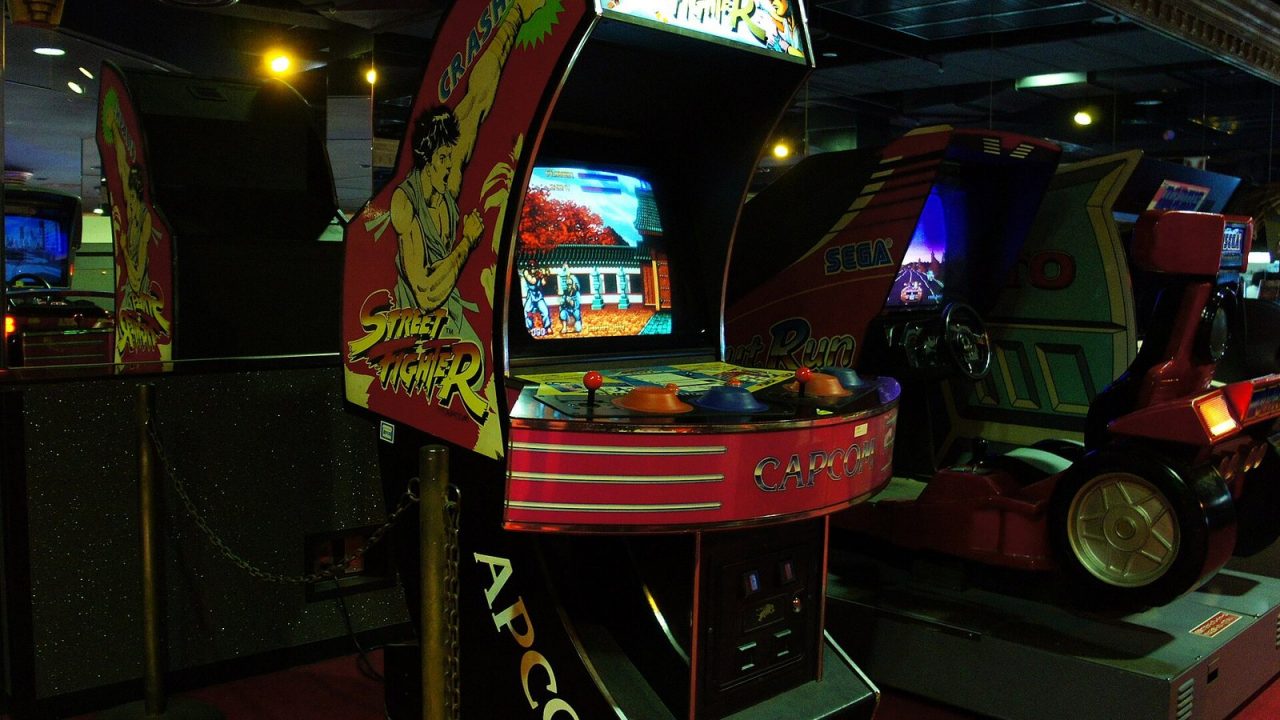
Every modern fighting game carries some Street Fighter DNA. Six-button layouts, quarter-circle fireballs, super meters, combos, parries and even the vocabulary players use to talk about them all trace back, directly or indirectly, to a Capcom arcade series that began in 1987. As of June 30, 2026, Capcom reports lifetime sales of 60 million units for the Street Fighter series, but the more interesting story is mechanical: each generation answered the problems of the one before it.
This is a history told through systems. Release dates and sales are included where they help, but the focus is on what changed in the way the games are played.
1987: Street Fighter and the First Special Moves
The original Street Fighter arrived in arcades in 1987, designed by Takashi Nishiyama and Hiroshi Matsumoto. The player controlled Ryu (with Ken as the second player’s character) and fought through a series of opponents from around the world.
Two of its ideas survived everything that came after. First, attacks came in three strengths of punch and kick, giving the series its six-button foundation. Some cabinets used large pressure-sensitive pads that measured how hard the player hit them instead, but the six-button layout is the one that lasted. Second, Ryu and Ken had hidden special moves performed with joystick motions: the Hadoken fireball, the Shoryuken uppercut and the Tatsumaki Senpukyaku hurricane kick. Those inputs, a quarter-circle forward and a “dragon punch” motion, are still the first things new players learn today. If the shorthand for them is unfamiliar, our guide to fighting game notation breaks it down.
The first game was stiff by later standards, and the special moves were difficult to perform consistently. But the template of a one-on-one duel with secret, skill-based techniques was in place.
1991–1994: Street Fighter II Builds the Genre
Street Fighter II: The World Warrior (1991), designed by Akira Nishitani and Akira Yasuda, is the moment the fighting game genre as we know it took shape. The changes were fundamental:
- A selectable roster. Eight playable World Warriors, each with distinct normal moves, special moves and play styles. Guile’s charge inputs, Zangief’s spinning piledriver and Dhalsim’s long limbs created matchups, not just stages.
- Throws. Close-range grabs gave players an answer to opponents who simply held block.
- Combos. Players discovered that certain attacks could be chained or canceled into special moves before the opponent could recover. This is widely described as a quirk the developers did not originally design for, but it became a defining feature of the genre and was embraced in later versions.
Rather than a direct sequel, Capcom iterated. Champion Edition (1992) made the four bosses playable and allowed mirror matches. Hyper Fighting (1992) increased the game speed and gave characters new moves. Super Street Fighter II (1993) added four new characters. Super Street Fighter II Turbo (1994) introduced the Super Combo, a powerful special move fueled by a meter that filled during play, and added the hidden boss Akuma.
That meter was a turning point. It gave players a resource to manage across a round and created the comeback-and-spend decisions that nearly every fighter since has used in some form. The commercial impact was enormous: Capcom’s own figures list Street Fighter II at 6.3 million units and Street Fighter II Turbo at 4.1 million (as of June 2026), and that only covers home releases, not the arcade boom that made the game a phenomenon.
1995–1998: The Alpha Series and Meter Experiments
With Street Fighter Alpha: Warriors’ Dreams (1995), Capcom went back in the timeline, set the series between the first two games, and adopted a brighter, more animated art style. Mechanically, Alpha was a laboratory for meter use:
- A three-level Super Combo gauge, letting players spend one, two or three levels for stronger supers.
- Alpha Counters, which spent meter to counterattack while blocking, giving defenders a way out of pressure.
- Chain Combos in the first game, which allowed normals to chain into each other in sequence.
Street Fighter Alpha 2 (1996) replaced chain combos with Custom Combos, a meter-powered mode in which players could string attacks freely for a short window. Street Fighter Alpha 3 (1998) introduced three selectable fighting styles, often called “-isms,” that changed how each character’s meter and defensive options worked. Choosing an -ism was effectively choosing a different version of your character.
The Alpha era showed how far a single roster could stretch when the systems around it changed. It also previewed a recurring Capcom habit: using a universal mechanic to reshape every character at once.
1997–1999: Street Fighter III and the Parry
Street Fighter III: New Generation launched in arcades in February 1997 with an almost entirely new cast and lavish hand-drawn animation. Ryu and Ken returned, but most characters were new.
Its defining mechanic was the parry: tapping toward the opponent (or down for low attacks) at the moment an attack connects negates it completely, with no chip damage, and leaves the attacker open. Parrying cost no meter, so it rewarded pure reads and timing. Each character also selected one of three Super Arts before the match, with different gauge lengths and stock counts depending on the choice.
2nd Impact (1997) added EX special moves, powered-up specials that spent part of the Super Art gauge, plus throw teching and character-specific taunts called Personal Actions. EX moves became a standard part of later Street Fighter games. Street Fighter III: 3rd Strike (1999) refined the balance and allowed parrying during blockstun with very tight timing, the so-called red parry.
Street Fighter III was not the commercial juggernaut that II had been, arriving as the arcade market cooled. But its competitive reputation grew over time, helped by Evo 2004’s “Evo Moment 37,” in which Daigo Umehara parried every hit of Justin Wong’s super. We compare that parry with later systems in our explainer on parry systems.
2008–2014: Street Fighter IV and the Revival
After nearly a decade without a new numbered entry, Street Fighter IV launched in Japanese arcades in 2008 and on home consoles in 2009. It used 3D models on a 2D plane and brought back the familiar Street Fighter II cast alongside newcomers, deliberately reaching out to lapsed players.
Its two signature mechanics were:
- Focus Attack. A move that could absorb a hit while charging and, when fully charged, crumple the opponent. Focus Attacks could be canceled with a dash, which became a cornerstone of advanced play for extending combos and making moves safer.
- Ultra Combo. A second gauge, the Revenge meter, filled as you took damage and powered a cinematic Ultra. It gave losing players a built-in comeback tool alongside the familiar Super Combo.
Capcom again iterated rather than replacing the game: Super Street Fighter IV and its Arcade Edition followed in 2010, and Ultra Street Fighter IV in 2014. The SFIV era coincided with the growth of online play and streaming, and it helped rebuild the tournament scene around a single shared game.
2016–2020: Street Fighter V and the Service Model
Street Fighter V launched in February 2016 for PlayStation 4 and PC with cross-platform play between them, a first for a mainline Street Fighter. It launched with a 16-character roster and was widely criticized for thin single-player content at release. Capcom added characters and modes over several years, culminating in Arcade Edition (2018) and Champion Edition (2020).
Mechanically, SFV gave each character a personalized system layer:
- V-Skill, a unique ability always available, such as a parry for Ryu or a short run for Ken.
- V-Trigger, a powered state or special action fueled by the V-Gauge, which filled as the player took damage or landed V-Skills. Later updates gave each character a second V-Trigger to choose from.
- V-Reversal, a gauge-spending counter from block.
- Crush Counters, where certain heavy attacks landing as counter-hits produced extra stun or juggle opportunities.
SFV also simplified execution compared with SFIV, with more lenient combo timing, steering the game toward neutral and decision-making. Despite its rocky launch, it became the best-selling Street Fighter title in Capcom’s own records, at 8 million units as of June 2026.
2023 Onward: Street Fighter 6 and the Drive System
Street Fighter 6 released on June 2, 2023, built on Capcom’s RE Engine. It made two big bets: one universal resource for everyone and a serious attempt to welcome new players.
The resource is the Drive Gauge, a bar of six segments that powers Drive Impact (an armored attack), Drive Parry and Perfect Parry, Drive Rush, Drive Reversal and Overdrive (EX) moves. Run it dry and your character enters Burnout, becoming vulnerable to chip damage and stuns until the gauge recovers. Because every defensive and offensive option draws from the same pool, the Drive Gauge ties together ideas from previous eras: III’s parry, IV’s armored Focus Attack and the EX moves that began in 2nd Impact.
For accessibility, SF6 introduced Modern controls, which let players perform special moves with a single button plus a direction, at the cost of slightly reduced damage. It also added real-time commentary, the single-player World Tour mode and the social Battle Hub. Our Street Fighter 6 beginner guide covers those modes in detail.
Capcom lists Street Fighter 6 at 7.2 million units as of June 30, 2026, which puts it close to Street Fighter V’s lifetime total. The game has continued to receive season-based character additions, and a Nintendo Switch 2 version launched in June 2025.
The Through-Line: What Each Era Added
| Era | Key game | Defining additions |
|---|---|---|
| 1987 | Street Fighter | Six attack strengths, motion-input special moves |
| 1991–1994 | Street Fighter II and updates | Selectable roster, throws, combos, Super Combo meter |
| 1995–1998 | Alpha series | Leveled supers, Alpha Counters, Custom Combos, -isms |
| 1997–1999 | Street Fighter III | Parry, Super Art selection, EX moves |
| 2008–2014 | Street Fighter IV | Focus Attack, dash cancels, Ultra Combos |
| 2016–2020 | Street Fighter V | V-Skill, V-Trigger, Crush Counters, cross-play |
| 2023– | Street Fighter 6 | Drive Gauge, Burnout, Modern controls |
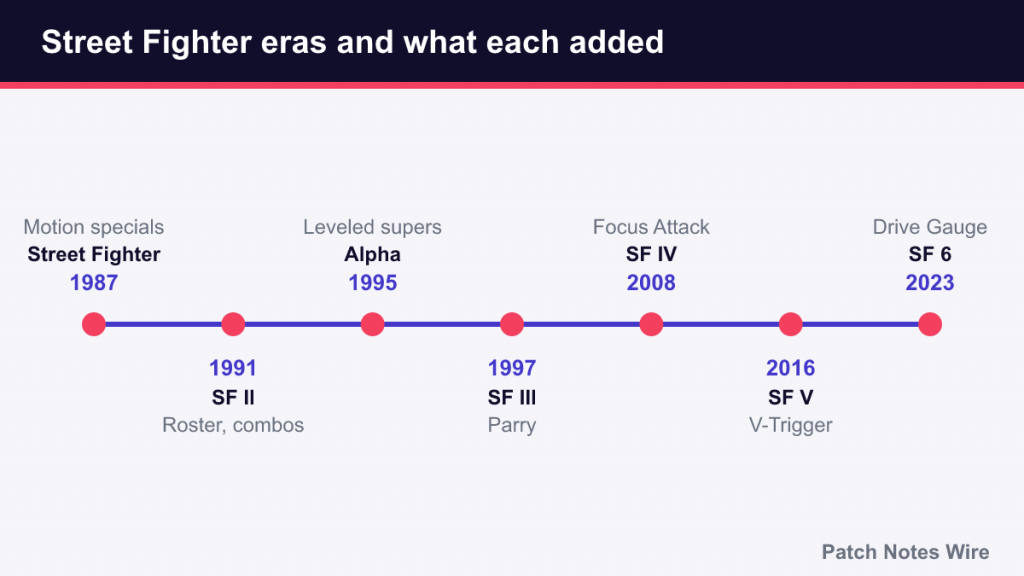
Read the table top to bottom and a pattern appears. Capcom alternates between giving players more freedom (combos, custom combos, parries) and giving them more structured resources to manage (super meter, Revenge meter, V-Gauge, Drive Gauge). Each new number tends to fold the best ideas of earlier games into a cleaner system, then adds one new idea big enough to define the next decade of play.
That is why the series still matters to people who never played the 1987 original. When a modern fighter asks you to spend meter on an enhanced special, read a parry or manage a gauge that doubles as your defense, it is speaking a language Street Fighter has been writing for almost forty years.