Parry Systems Explained: From Street Fighter III to Sekiro
How parries work in Street Fighter III, SF6, Garou, Sekiro, Metal Gear Rising and Bayonetta, and why the risk/reward trade-off makes them so satisfying.
Blocking says “I will take a little less damage.” A parry says “I knew exactly when that was coming.” That difference is why parry mechanics produce some of the loudest moments in both fighting games and action games. A well-timed parry turns defense into offense in a single input, and the designers who build them have to answer the same question every time: how much should a player be rewarded for reading the opponent correctly, and how much should they pay for guessing wrong?
Below are the most influential parry and deflect systems, from Street Fighter III to Sekiro, and the design logic behind each.
What Makes a Parry Different From a Block
A block is a state you hold: forgiving about timing, but it leaves you in blockstun, may cost chip damage and hands the initiative to the attacker. A parry is an action you time just before the hit lands. Get it right and you earn something blocking never gives, such as an opening, a resource, a stagger or slowed time. Get it wrong and you are usually stuck in an animation that leaves you exposed.
Almost every parry system can be described with four variables:
- Timing window. How precise the input has to be. Tight windows make parries feel heroic; loose ones make them a routine tool.
- Cost. Whether a parry uses a meter, stamina, or nothing at all.
- Reward. What a success gives you: frame advantage, a free punish, health back, posture damage, or a special counter.
- Failure state. What happens when you miss: recovery frames, vulnerability to throws, or simply getting hit.
If you want a refresher on how startup and recovery frames make these windows concrete, our guide to frame data covers the vocabulary used throughout this article.
Street Fighter III: The Parry That Defined a Generation
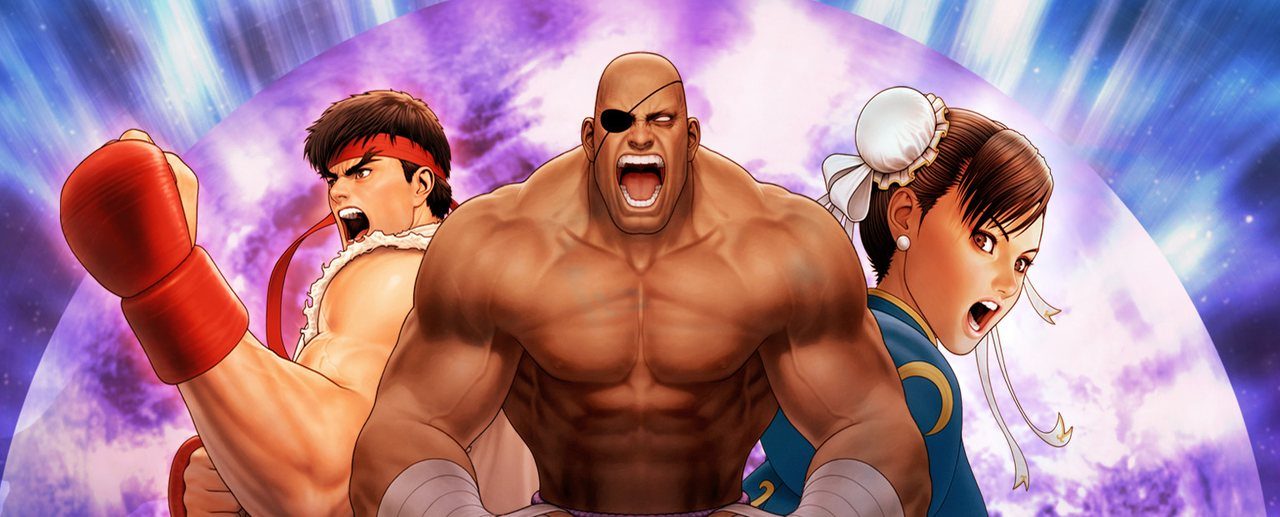
Street Fighter III: New Generation arrived in arcades in early 1997, and its headline defensive mechanic was the parry (sometimes called “blocking” in Japanese materials). Instead of holding back, the player taps the stick toward the opponent, or down for low attacks, at the exact moment an attack is about to connect. A successful parry takes no damage at all, even from special moves and Super Arts that would normally inflict chip damage on block, and it leaves the opponent open to a counterattack.
The design was radical for its time because it cost nothing. There was no meter to spend. The only price was risk: tapping forward when the attack did not come meant you were walking toward your opponent rather than blocking. Every parry attempt was a prediction.
Later versions refined the idea. Street Fighter III: 3rd Strike (1999) let players parry during blockstun with precise timing, a technique known as a guard parry or “red parry” because the character flashes red. That gave defenders a way to escape pressure they had already started blocking, but the timing is notoriously demanding.
The most famous demonstration came at Evo 2004, when Daigo Umehara parried the full multi-hit sequence of Justin Wong’s Chun-Li super while on a sliver of health and then won the round. “Evo Moment 37” is still the shorthand for what a parry can do: it turns an attacker’s best play into the defender’s opportunity.
Because it was free, the SFIII parry made projectiles in particular far less threatening against a confident player. Later Street Fighter games kept the idea but attached costs and limits.
Garou: Mark of the Wolves and Just Defend
SNK’s answer came in 1999 with Garou: Mark of the Wolves. Its Just Defend system asks the player to block, rather than tap forward, at the very last moment before an attack hits. The input is a normal block with tighter timing, which makes the window feel more forgiving than SFIII’s forward tap.
The reward is subtler. A Just Defend restores a small amount of health, lets the defender recover from blockstun faster than a normal block, and prevents the attacker from building toward a guard crush. You do not get a full free punish every time, but a string of Just Defends shortens your opponent’s pressure and slowly swings momentum.
Garou shows a useful design principle: a parry does not have to be all-or-nothing. A “perfect block” that improves your situation slightly can be just as important to the meta as a dramatic counter, because players attempt it far more often.
Street Fighter 6: Drive Parry and Perfect Parry
Street Fighter 6 (2023) brought parrying back, but wrapped it in the Drive Gauge, the resource bar that also powers Drive Impact, Drive Rush and Drive Reversal. With Classic controls, Drive Parry is performed by pressing Medium Punch and Medium Kick together; Modern controls have a dedicated button.
The system has two layers:
- Drive Parry (held). Holding the parry puts your character in a defensive stance that catches strikes and projectiles. Holding it drains the Drive Gauge, while successfully parrying attacks gives some gauge back. It is a strong answer to fireballs and safe pressure that would otherwise slowly chip away your gauge.
- Perfect Parry (timed). Pressing parry at the precise moment an attack lands produces a Perfect Parry, signaled by a brief slowdown and a distinctive visual effect. It opens the attacker up to a punish, but the follow-up combo is heavily damage-scaled, so it rewards accuracy without letting one read end a round.
The failure states are what keep it honest. A parry that catches nothing has noticeable recovery, so a read on your parry gives the opponent a punish. Parrying is also vulnerable to throws, and SF6 rewards throwing a parrying opponent, which creates a guessing game: strike, throw, or wait. On top of that, parry spends the same gauge you need to avoid Burnout, so every parry is also a resource decision.
Compared with SFIII, SF6 makes parrying easier to perform, then limits it with cost, throws and damage scaling: accessible, but expensive to overuse.
Sekiro: When the Whole Game Is a Parry
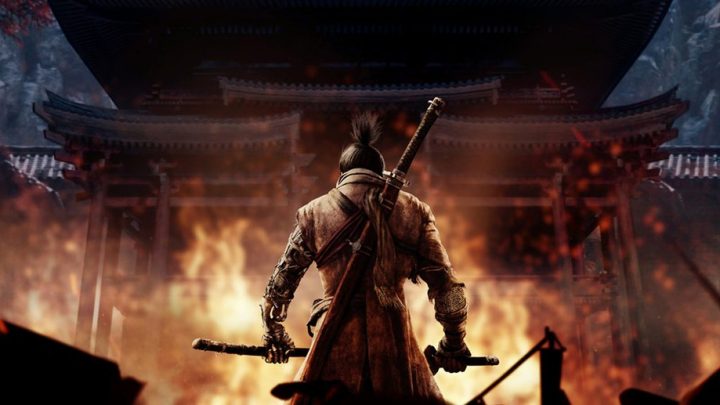
FromSoftware’s Sekiro: Shadows Die Twice (2019) took the idea further than most action games by building its entire combat loop around the deflect. Holding the guard button blocks. Pressing it just before an attack lands deflects it, producing a sharp clang and a shower of sparks.
The key is what a deflect does to the enemy. Sekiro replaces the usual “chip away the health bar” approach with a posture system. Deflects and attacks both build up the enemy’s posture damage, and when their posture breaks, Wolf can land a deathblow. Enemies recover posture more slowly when their vitality is low, so health damage and deflects work together rather than competing. Meanwhile, the player’s own posture also fills when blocking without deflecting, which pushes you toward precise timing rather than turtling.
Sekiro also builds exceptions into the system. Perilous attacks, marked with a red warning symbol, cannot simply be deflected: thrusts can be countered with the Mikiri Counter, sweeps should be jumped (often followed by a jump kick), and grabs must be dodged. That variety stops the deflect from becoming a single button the player can spam through every fight. For a closer look at how dodging fits into this kind of design, see our explainer on invincibility frames.
The design intention is clear. Sekiro wants fights to feel like sword duels, with a rhythm of clashing blades rather than rolling around enemies.
Metal Gear Rising: A Parry With No Block Button
PlatinumGames’ Metal Gear Rising: Revengeance (2013) is famous for its unusual choice: Raiden has no dedicated block button. Instead, players tilt the left stick toward the attacking enemy and press light attack. It sounds strange, but it works because Raiden’s whole kit is about aggression. Defense is performed with the same button you use to attack.
A regular parry stops the hit and lets you continue your offense. A parry timed at the last possible moment becomes a perfect parry, where Raiden automatically follows up with a counterattack that often opens the enemy up for Blade Mode and Zandatsu, the slice-and-grab finisher that restores health and energy.
The quirks matter. The direction is toward the enemy, not toward the incoming attack, which confuses many new players. You also need the stick to return to neutral between consecutive parries. And some attacks cannot be parried at all, forcing the player to dodge instead. Many of the game’s well-known boss fights are effectively parry exams built around these rules.
Bayonetta and Other Counter-Based Designs
Not every action game uses a true parry. Bayonetta (2009) centers its defense on dodging: a dodge timed at the last moment triggers Witch Time, a slowdown that lets the player punish freely. In function, it plays the same role as a parry, rewarding a precise read with a big window of offense, but the input is a dodge rather than a block.
The first game also offers an optional accessory, the Moon of Mahaa-Kalaa, that adds a parry: flicking the stick toward an enemy as it attacks deflects the blow and, in that game, can trigger Witch Time. It is a good example of a parry added as a tool for advanced players rather than a core requirement.
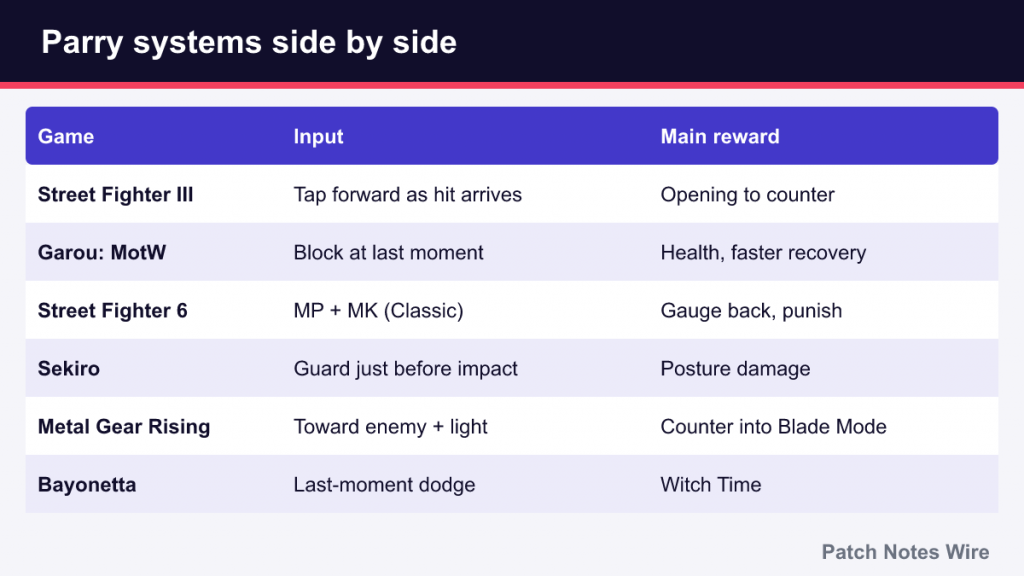
Comparing the Systems Side by Side
| Game | Input | Cost | Main reward | Main risk |
|---|---|---|---|---|
| Street Fighter III | Tap forward (or down for lows) as the hit arrives | None | No damage, opening for a counterattack | Wrong read means you are not blocking |
| Garou: Mark of the Wolves | Block at the last moment (Just Defend) | None | Small health recovery, faster recovery from blockstun | Mistimed input is just a normal block or a hit |
| Street Fighter 6 | Medium Punch + Medium Kick (Classic) | Drive Gauge while held | Gauge back on success; Perfect Parry opens a scaled punish | Whiff recovery, throws, Burnout pressure |
| Sekiro | Guard button just before impact | None | Posture damage toward a deathblow | Late or early timing builds your own posture or gets you hit |
| Metal Gear Rising | Stick toward enemy + light attack | None | Perfect parry counter into Blade Mode | Unparryable attacks, wrong direction |
| Bayonetta | Last-moment dodge (Witch Time); parry via accessory | None | Slowed time for free punishes | Some enemies resist or deny Witch Time |
Designing Risk and Reward: Why Parries Feel So Good
Parries reward anticipation, give instant feedback and flip the power dynamic in a moment. The design problem is constant: too strong and the game becomes a timing test; too weak and nobody bothers.
The solutions fall into a few families:
- Make it expensive. SF6 charges Drive Gauge, which also protects you from Burnout, so parrying competes with offense for the same resource.
- Make it beatable. Throws in SF6, perilous attacks in Sekiro and unparryable moves in Metal Gear Rising all ensure there is a counter to the counter.
- Scale the payoff. SF6’s damage scaling after Perfect Parry and Garou’s modest Just Defend rewards keep a single read from deciding a match.
- Make it the whole game. Sekiro accepts that deflecting is the core loop and designs every enemy around testing it in different ways.
When you pick up a new game with a parry, these questions are the fastest way to understand it. What does it cost? What beats it? How much do I get for landing one? Once you know those three answers, you know when parrying is a habit and when it is a gamble.