Bayonetta Series Guide: Witch Time, Play Order and What Makes It Special
Every Bayonetta game in order, where to play them today, how Origins fits in, and the combat ideas that make PlatinumGames' witch a genre icon.
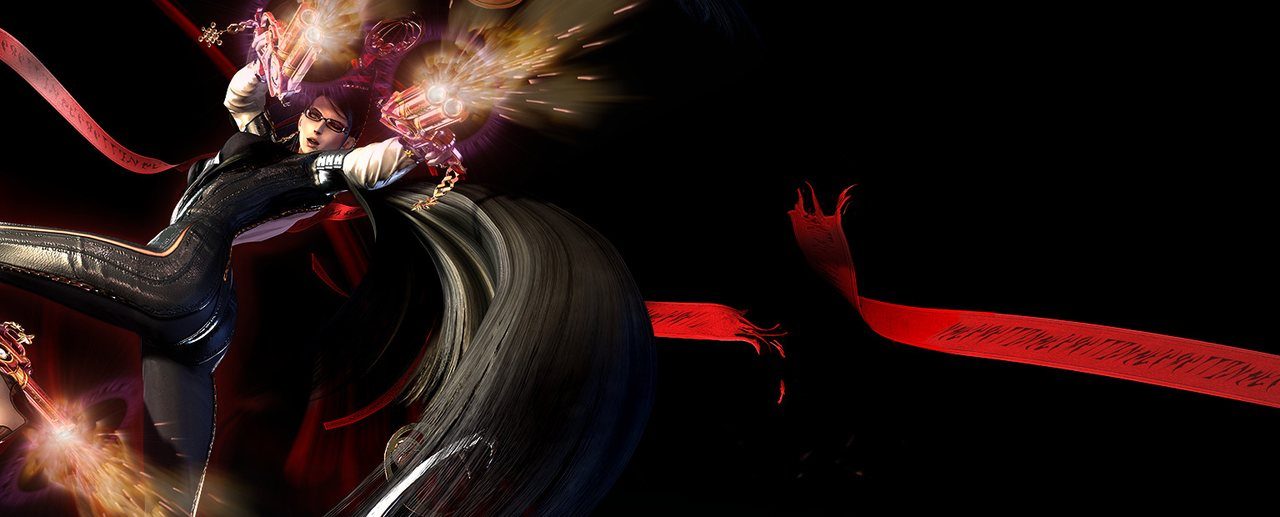
Bayonetta is one of the few character action series that can stand next to Devil May Cry without living in its shadow. It is loud, stylish and occasionally absurd, but underneath the spectacle sits one of the most carefully tuned combat systems in the genre. Four games carry the name: three mainline action titles and one storybook spin-off that plays nothing like the others. This guide covers them all, explains how the platforms changed over the years, and breaks down the core ideas that make the combat feel different from its rivals.
The Games at a Glance
All four games were developed by PlatinumGames. The first was published by Sega; from Bayonetta 2 onward the series has been published by Nintendo, which is why the newer entries are Switch-only.
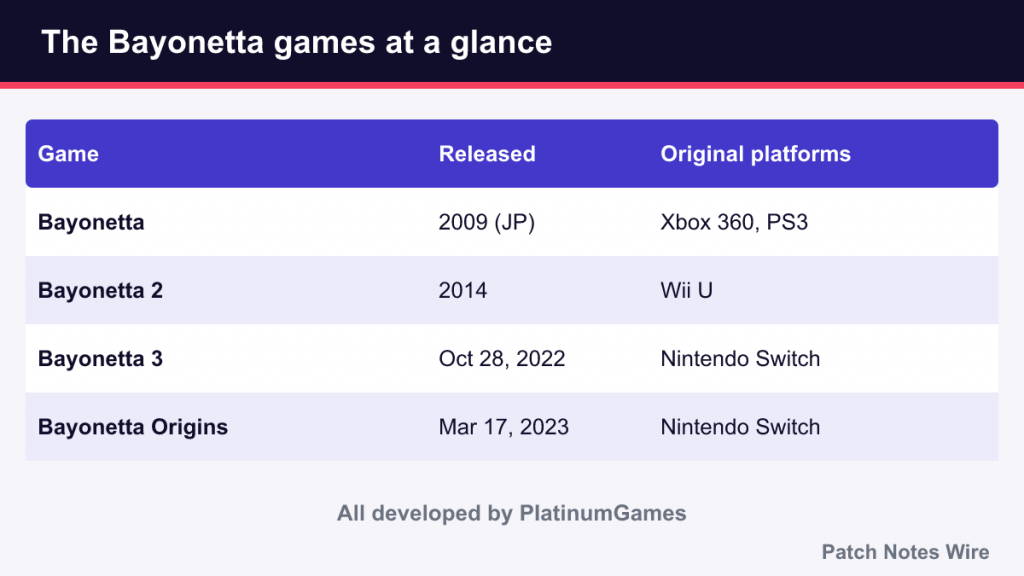
| Game | Original release | Original platforms | Director |
|---|---|---|---|
| Bayonetta | October 2009 (Japan), January 2010 (West) | Xbox 360, PlayStation 3 | Hideki Kamiya |
| Bayonetta 2 | September 2014 (Japan), October 2014 (West) | Wii U | Yusuke Hashimoto |
| Bayonetta 3 | October 28, 2022 | Nintendo Switch | Yusuke Miyata (Kamiya supervising) |
| Bayonetta Origins: Cereza and the Lost Demon | March 17, 2023 | Nintendo Switch | Abebe Tinari |
There is also 8-Bit Bayonetta, a tiny retro-style browser minigame released in 2015 and later put on Steam. It is a curiosity rather than part of the story, and you can skip it without missing anything.
Where to Play Each Game Today
The platform history is messier than the release list suggests, so here is how things stand as of 2026.
Bayonetta (2009)
The original has been ported more than any other entry. After the Xbox 360 and PlayStation 3 launch, it came to Wii U in 2014 (bundled with Bayonetta 2), to Windows via Steam in April 2017, to Nintendo Switch in February 2018, and to PlayStation 4 and Xbox One in February 2020 as part of a tenth-anniversary bundle with Vanquish. For most players, the PC, Switch and PS4/Xbox One versions are the practical choices. The original PlayStation 3 port was widely criticized at launch for its performance, so it is not the version to seek out.
Bayonetta 2 (2014)
Bayonetta 2 exists because Nintendo stepped in to publish it. It launched as a Wii U exclusive and was ported to Switch in February 2018. It has never appeared on PlayStation, Xbox or PC, so a Switch (or a Switch 2 running Switch software) is the way to play it now.
Bayonetta 3 and Origins
Both are Switch exclusives published by Nintendo. Neither has been ported elsewhere.
Recommended Play Order
The simplest answer is also the best one: play the three mainline games in release order. The story of Bayonetta 2 assumes you know the characters and events of the first game, and Bayonetta 3 leans on both. The combat also builds up across the trilogy, so starting with the first game lets you learn the fundamentals before the sequels pile on new systems.
- Bayonetta – the foundation. Learn Witch Time, Dodge Offset and how the ranking works.
- Bayonetta 2 – faster, brighter and a little more forgiving, with the Umbran Climax mechanic.
- Bayonetta 3 – the most experimental entry, built around summoning and controlling demons.
- Bayonetta Origins – optional, and best treated as its own thing.
Where does Origins fit? It is a prequel set roughly six centuries before the first game, following a young Cereza (Bayonetta’s real name) as she enters the forbidden Avalon Forest with her demon companion Cheshire. You can play it at any point, but it lands harder after Bayonetta 3, since it fleshes out characters and relationships that the third game touches on. Playing it first is also fine if you simply want a gentler introduction to the world.
What Each Game Brings to the Table
Bayonetta: the blueprint
Hideki Kamiya, who had directed the original Devil May Cry, built Bayonetta around a single principle: defense should feel like offense. The game rewards you for dodging at the last possible moment rather than for blocking, and it lets you keep combos alive while you evade. Its chapters are divided into “verses,” each graded with a medal, and the whole package is famous for its high replay value, from unlockable weapons to the punishing top difficulty, Non-Stop Infinite Climax.
Bayonetta 2: refinement and speed
Directed by Yusuke Hashimoto with Kamiya supervising, the sequel keeps the core system but tightens the pacing. Its headline addition is Umbran Climax, a mode that turns Bayonetta’s finishers into enormous demon-powered strikes for a short window. Many fans consider it the most approachable mainline game because it is generous with resources and rarely stalls between fights. It also added a co-operative challenge mode, Tag Climax.
Bayonetta 3: summons and Demon Slave
The third game changes the formula more than any sequel before it. Instead of brief cinematic summons, Bayonetta can now directly control her Infernal Demons through a system called Demon Slave, puppeteering giant creatures while she stays exposed on the battlefield. Demon Masquerade lets her fuse with a demon for new attacks and traversal. It also introduces a second playable character, Viola, whose combat works very differently: she triggers Witch Time by parrying rather than by dodging, and her demon Cheshire fights independently. Bayonetta 3 also saw a change of English voice actress, with Jennifer Hale taking over the role.
Bayonetta Origins: a different genre
Origins is an action-adventure game with a hand-painted storybook look. You control Cereza and Cheshire at the same time with a twin-stick scheme: Cereza binds enemies with spells and solves puzzles, while Cheshire does the heavy hitting. There are no style rankings, no Witch Time and no long combo strings. Anyone expecting a fourth Bayonetta should adjust expectations; anyone who enjoys games like Brothers: A Tale of Two Sons will feel at home.
The Core Combat Hooks, Briefly
Bayonetta’s combat has a reputation for being complicated, but its key ideas are easy to state. A deeper look at each one deserves its own article, so this is the short version.
Witch Time
Dodge an enemy attack at the very last moment and time slows down for everyone except Bayonetta. During that window you can land a long combo with no risk of being hit back. It is the series’ signature mechanic and the reason it plays so differently from block-heavy action games: your defense is your best opening for damage. If you want the general theory behind last-moment evasion, our explainer on invincibility frames covers how dodges work under the hood.
Dodge Offset
In most action games, dodging cancels your combo. In Bayonetta, if you keep the attack button held while you dodge, the combo continues where it left off once you come out of the evade. This lets you finish long strings and their big finishers even while dodging through enemy attacks. It is the least obvious mechanic for newcomers and the one that unlocks the most once it clicks.
Wicked Weaves
Many combos end with a Wicked Weave, a giant demonic fist or heel summoned from Bayonetta’s hair. These hits have huge reach and damage. Knowing which strings end in a Weave, and spacing them so they land on groups, is a big part of efficient play.
Torture Attacks and Climaxes
Filling the magic gauge lets you perform Torture Attacks, cinematic executions using devices like guillotines and iron maidens, which deal heavy damage and often drop a weapon you can pick up. Boss fights typically end in a Climax finisher. In Bayonetta 2 the Umbran Climax gave you an alternative way to spend that gauge, and Bayonetta 3 replaced both systems with direct demon control.
Ranking and replay
Every fight (verse) is graded on time, combo score and damage taken, and those grades roll into a chapter medal. If you are curious how grading systems compare across the genre, see our guide to style ranking systems.
Which Game Should a Newcomer Start With?
Most people should simply start with the first Bayonetta on whichever modern platform they own. It is the best tutorial for the series’ ideas and still holds up well. A few exceptions:
- If you only own a Switch, you can play all four games there, so start with the first and move forward.
- If action games intimidate you, the first game’s Easy and Very Easy settings offer an automatic mode that strings elaborate combos together from a single button. It is a legitimate way to enjoy the story and spectacle.
- If you have played Devil May Cry, expect a lighter emphasis on stylish weapon-swapping and a heavier emphasis on timing dodges. The muscle memory transfers less than you might think.
- If you want something calm, Origins can be played on its own, but its story will mean more after the mainline games.
Common Mistakes New Players Make
- Treating the dodge as an escape button. Rolling away early gives you nothing. Waiting for the strike and dodging late gives you Witch Time. Practise on basic enemies until the timing feels natural.
- Letting go of the attack button while dodging. Dodge Offset only works if you keep the button held. Releasing it throws away your combo.
- Ignoring weapon swaps. Bayonetta can carry two weapon sets and switch between them mid-fight. Many advanced combos depend on switching at the right moment.
- Judging the game by its first medals. Low ranks on a first run are normal. The grading is designed for replays once you know the encounters.
- Skipping the practice screen. The loading screens in the original game double as a small practice space where you can try combos. It is an easy way to learn strings without pressure.
Why the Series Matters
Bayonetta arrived in 2009, eight years after Devil May Cry had defined the modern character action game, and pushed the genre in a new direction. Its emphasis on precise evasion over blocking, combined with a generous combo system that never punishes you for dodging, influenced how later action games thought about defense. Its survival is also a rare story in the industry: Bayonetta 2 was effectively rescued by Nintendo’s decision to publish it, and the series has remained with Nintendo since. Series creator Hideki Kamiya left PlatinumGames in 2023, so whatever comes next for the witch, the trilogy plus Origins is the complete set to play today.

Whether you come for the spectacle, the scoring or the pure feel of a perfectly timed dodge, the trilogy remains one of the best places to learn what character action games are about.