Mortal Kombat 1 Beginner Guide: Kameos, Blocking and Core Mechanics
Learn Mortal Kombat 1's block button, Kameo Fighters, super meter, Fatal Blows, dial combos and movement, plus how MK plays differently from SF and Tekken.

Mortal Kombat is famous for Fatalities, but the part that decides matches happens long before anyone rips out a spine. Mortal Kombat 1, NetherRealm Studios’ reboot of the series, launched on September 19, 2023 for PlayStation 5, Xbox Series X|S, Nintendo Switch and PC. It keeps the series’ distinctive feel, with a dedicated block button and combo strings entered like a phone number, and adds a partner system called Kameo Fighters that changes how every character plays.
If you are coming from Street Fighter or Tekken, some habits carry over and some will actively hurt you. If this is your first fighting game, its compact move lists make it a reasonable place to start.
The Controls: Four Attacks, a Block Button and a Partner
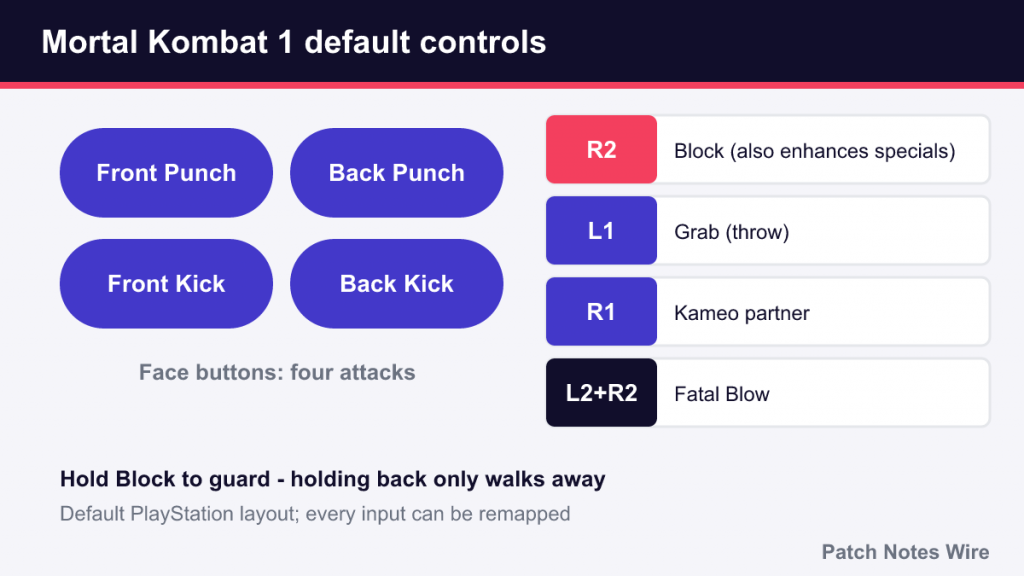
Mortal Kombat 1 uses a layout that is different from most fighting games. Instead of light, medium and heavy, the four attack buttons are named after limbs and their position relative to the camera:
- Front Punch and Back Punch
- Front Kick and Back Kick
- Block, which also serves as the button to enhance special moves
- Grab (throw)
- Kameo, which calls your partner fighter
On a PlayStation pad, the defaults put the four attacks on the face buttons, Grab on L1, Block on R2 and Kameo on R1. Fatal Blow is performed with L2+R2. Every input can be remapped in the settings, which is worth doing if you play on a stick or leverless controller.
The Dedicated Block Button
The biggest adjustment for players from other series is that you do not block by holding back. You hold the Block button. Holding back simply walks you away from your opponent. Standing block stops high and mid attacks, while holding down and Block together crouch-blocks, which you need for low attacks. Overheads, which hit crouching opponents, must be blocked standing.
In practice, cross-ups are less of a guessing game because the Block button does not depend on which way you face, but you cannot walk back and block at the same time.
Advanced Blocking: Up Block and Flawless Block
Two blocking techniques are worth knowing early:
- Up Block – pressing up while holding Block performs a special block that is strong against jump-ins and stops the attacker from canceling their blocked attack into a special move. It is a defensive tool for specific moments, not something to do constantly.
- Flawless Block – blocking at the last moment before a hit lands. It removes chip damage (useful against projectiles) and denies the attacker the meter they would normally gain.
Kameo Fighters: The Partner System
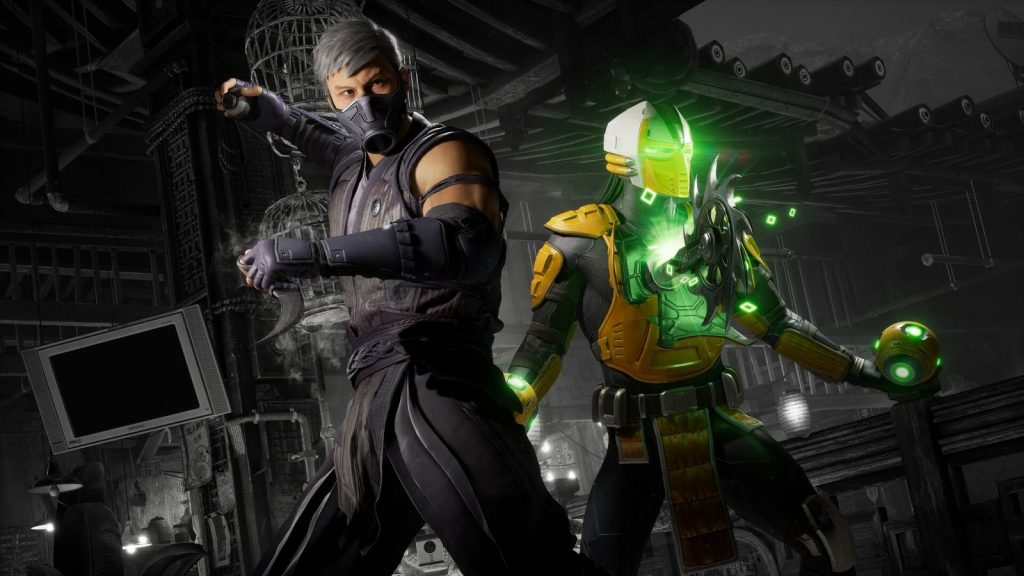
Kameos are Mortal Kombat 1’s defining addition. Before each match you choose a main fighter and, separately, a Kameo Fighter, a partner who jumps in to perform a short attack or ability when you press the Kameo button. Kameos are drawn from series history, with some characters appearing in both the main roster and the Kameo roster in different forms. The base game included 15 Kameos, and six more were added after launch.
How Kameos Work
Your Kameo has its own gauge, separate from your super meter. Each Kameo action uses part of that gauge, and it refills over time. Kameo moves are mapped to the Kameo button combined with directions, so each partner offers a few different abilities such as projectiles, anti-airs, armored attacks, combo extenders or utility moves.
Kameos are used to:
- Extend combos – calling the partner in the middle of a combo lets you continue it where your main fighter alone could not.
- Cover weaknesses – a character with no reliable projectile can pair with a Kameo who has one; a slow character can gain a fast pressure tool.
- Defend – some Kameo calls are used to escape pressure.
- Power Combo Breakers and Fatal Blows – both involve your Kameo, as covered below.
The chosen Kameo also affects your starting health, so pairings involve a small trade-off. For beginners, a simple assist you remember to call often is worth more than a powerful one you forget exists.
Super Meter: Enhanced Specials, Breakers and Armor
Below your health bar sits the super meter, divided into three bars. It fills as you use special moves, deal damage and have your specials blocked. Spending it is the main resource decision in a match.
| Use | How it works | When it matters |
|---|---|---|
| Enhanced special | Press Block during a special move to power it up, usually for one or two bars depending on the move | Extra damage, longer combos, better properties |
| Armored special | Some enhanced specials gain armor, absorbing hits as they start up | Escaping pressure when you have meter |
| Combo Breaker | Hold Block and forward while being hit; costs a large share of super meter and needs your Kameo available | Stopping a long or round-ending combo |
Because meter is shared between offense and defense, every enhanced special is a bar you will not have for a Breaker later. A common beginner pattern is spending meter on every combo and then having no answer when the opponent starts a long combo of their own. Holding enough for a Breaker in a close round is often the smarter play.
Fatal Blow
When your health drops to 30% or below, Fatal Blow becomes available, shown by an indicator under your health bar. It is a cinematic super attack in which your main fighter and your Kameo attack together for heavy damage. If it lands, it cannot be used again that match. If it misses or is blocked, you are open to a punish.
As the comeback mechanic, it makes the leading player more careful about pressing buttons. It is roughly Mortal Kombat’s equivalent of Tekken’s Rage Art, which we cover in our Tekken 8 beginner guide.
Dial Combos and Air Combos
Mortal Kombat combos are built from dial combos, also called strings: fixed button sequences entered one after another, such as Front Punch, Back Punch, Back Kick. Each character’s move list shows their strings. You do not need the tight timing of a Street Fighter link; you enter the next button as the previous hit connects, and the game chains them together.
Strings often end in a cancel into a special move, and that special can launch the opponent. Mortal Kombat 1 brought back an airborne combo system from earlier entries such as Armageddon and Shaolin Monks, so a typical route is a launching string, a Kameo call or dash to continue, another string or special to carry the juggle, and an ender that deals damage or carries to the corner.
Strings also come with risk. Some are safe when blocked, others leave you open. Checking which strings are safe is exactly what frame data is for, and MK1’s move list shows frame information for each move in practice mode.
Hit Confirming
Because many strings end in a special move that is unsafe on block, the most valuable skill after basic combos is hit confirming: seeing whether the first part of a string hit before committing to the special. If it was blocked, stop at the safe part of the string. If it hit, finish into the special and the full combo.
Movement: Dashes and Cancels
Tapping forward twice dashes forward, and tapping back twice backdashes. Backdashing is one of the main ways to escape close-range pressure, because it moves you out of range quickly. Dashes can also be canceled: pressing down during a dash stops it, after which you can dash again or attack. Dash-canceling lets players cover ground in short, controlled bursts instead of committing to a full dash.
Jumping exists as in any 2D fighter, but jump-ins are risky against a prepared opponent, especially one ready to Up Block or anti-air. On knockdown, you can delay your wake-up to make the attacker’s timing harder, or use certain Kameo calls or armored moves with meter to fight back.
How Mortal Kombat Differs From Street Fighter and Tekken
| Element | Mortal Kombat 1 | Street Fighter 6 | Tekken 8 |
|---|---|---|---|
| Blocking | Dedicated Block button | Hold back | Hold back (or stand still) |
| Combos | Dial strings, juggles, Kameo extensions | Links, cancels, target combos | Strings, launchers, juggles, wall combos |
| Movement | 2D, dashes and dash cancels | 2D, walk, dash and Drive Rush | 3D, sidesteps and backdash |
| Assist | Kameo Fighter | None | None |
| Comeback tool | Fatal Blow (30% health) | Critical Art at low health | Rage and Rage Art |
The practical differences for newcomers: in Street Fighter, special moves are motion inputs that require timing, and the Drive Gauge is a central resource, as explained in our Street Fighter 6 beginner guide. In Mortal Kombat, many specials use simple directional inputs like back, forward plus a button, and the main resources are super meter and the Kameo gauge. Tekken requires learning far more moves per character and adds a third dimension. Mortal Kombat sits closer to Street Fighter in its 2D plane, but its block button and dial strings give it a rhythm of its own.
Modes for Learning and Playing
- Tutorials and Practice – start with the basic and advanced tutorials, then the character tutorial for your main. Practice mode lets you record the dummy, check frame data and drill combos.
- Story – a cinematic campaign that rotates through many characters, useful for sampling the roster.
- Towers – the classic arcade ladder with an ending for each fighter.
- Invasions – a seasonal mode mixing fights with board-game and RPG-style progression; each season lasts roughly six weeks and rewards cosmetics.
- Online – casual and ranked play using rollback netcode, with cross-play across platforms. Switch cross-play was added on February 27, 2024.
Post-Launch Content, Dated
Mortal Kombat 1’s support ran in waves. Kombat Pack 1 added six fighters, including Omni-Man, Quan Chi, Peacemaker, Ermac, Homelander and Takeda, rolling out between November 2023 and mid-2024. The Khaos Reigns story expansion launched on September 24, 2024 with Noob Saibot and new versions of Cyrax and Sektor, while Kombat Pack 2 added guests Ghostface, the T-1000 and Conan the Barbarian, the last of whom arrived on January 21, 2025. Animalities returned in a free update alongside Khaos Reigns. A Definitive Edition bundling all post-launch content was released on May 14, 2025, and in May 2025 the developers said no further DLC characters or story chapters were planned.
For a newcomer in 2026, that means the roster is complete and stable. Balance will not shift underneath you, guides stay accurate longer, and the Definitive Edition is the simplest way to own everything.
A First-Week Plan
- Finish the basic and advanced tutorials so the Block button, Kameo calls and meter feel natural.
- Pick one main and one Kameo. Learn two safe strings, one punish combo and one combo that uses your Kameo.
- Practice blocking low with down and Block, and standing block on overheads, by setting the dummy to random high and low attacks.
- Play Towers or casual online matches, focusing on one thing per session: blocking, confirming, or meter management.
- Learn when you are allowed to press: if your string or special is unsafe on block, stop using it as a pressure tool and find a safe alternative.
Mortal Kombat 1 asks less memorization up front than Tekken and less execution than classic Street Fighter, but it rewards smart resource use more than either. Knowing when to spend meter, when to save a Breaker and when your Kameo is ready to cover you is what turns a pile of strings into a game plan. Once that clicks, the Fatalities are just the victory lap.